Diltiazem
A benzothiazepine calcium channel blocker, diltiazem limits the entry of calcium into cardiac and vascular smooth-muscle cells. Less calcium means slower conduction through the heart's pacemaker tissue and relaxation of arterial walls, so the drug both lowers heart rate and eases the workload of the heart. These actions make it useful in high blood pressure, angina, and rate control of atrial fibrillation. A small molecule (C22H26N2O4S) with a short half-life of about 3 to 4.5 hours, it is frequently given in extended-release forms to maintain steady effect. Its rate-slowing property means it is generally avoided alongside certain other heart-slowing medicines, since the combination can depress cardiac function excessively. Diltiazem is an approved cardiovascular drug used for both blood-pressure and rhythm indications.
A calcium channel blocker used to treat high blood pressure, angina, and certain heart rhythm abnormalities, including atrial fibrillation. It reduces the amount of calcium entering heart muscle and blood vessel smooth muscle cells, lowering heart rate and relaxing blood vessels. It should not be combined with certain other heart medications as dangerous interactions can occur.
Berat Molekul
414,5190 g/mol
LogP
3,10
TPSA
84,40 Ų
Lipinski RO5
Lulus
Area Terapeutik
Kelas Obat
Mekanisme Kerja
Benzothiazepine calcium channel blocker.
Pharmacokinetics (PK)
Pharmacodynamics (PD)
Benzothiazepine calcium channel blocker.
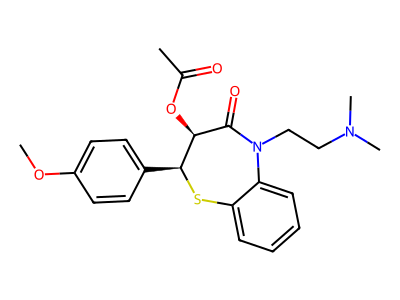
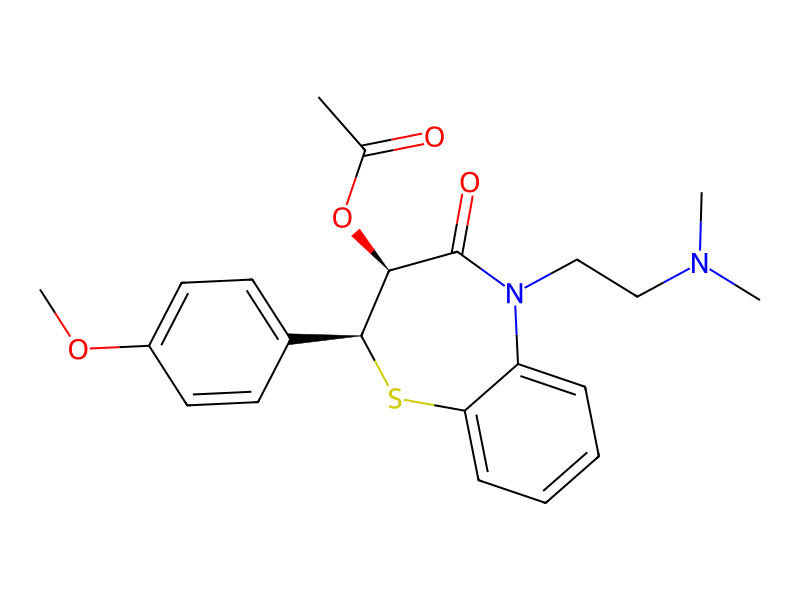
Struktur 2D
Cite this structure
Embed this structure
SMILES
COc1ccc([C@@H]2Sc3ccccc3N(CCN(C)C)C(=O)[C@@H]2OC(C)=O)cc1
InChI
InChI=1S/C22H26N2O4S/c1-15(25)28-20-21(16-9-11-17(27-4)12-10-16)29-19-8-6-5-7-18(19)24(22(20)26)14-13-23(2)3/h5-12,20-21H,13-14H2,1-4H3/t20-,21+/m1/s1
Molecular Formula
C22H26N2O4S
HBD / HBA
- / 6
Ikatan yang Dapat Dirotasi
7
Atom Berat
29
Diltiazem is a potent CYP3A4 inhibitor that significantly increases quetiapine plasma concentrations, raising risk of quetiapine toxicity and QT prolongation.
Diltiazem combined with metoprolol increases the risk of bradycardia and AV block through additive negative chronotropic and dromotropic effects.
Diltiazem (calcium channel blocker) combined with lithium may increase risk of lithium toxicity and neurotoxic adverse effects including bradycardia.
Diltiazem inhibits CYP3A4 and P-glycoprotein, increasing tacrolimus blood concentrations by 40–70% and heightening the risk of dose-related tacrolimus toxicity.
Diltiazem inhibits CYP3A4-mediated methylprednisolone metabolism, increasing methylprednisolone exposure and the risk of steroid side effects including immunosuppression, hyperglycaemia, and hypertension.
Diltiazem inhibits CYP3A4-mediated tamsulosin metabolism, increasing tamsulosin plasma concentrations by up to 2-fold and heightening the risk of orthostatic hypotension and dizziness.
Diltiazem increases dabigatran plasma levels through P-glycoprotein inhibition, potentially raising bleeding risk without a change in INR (dabigatran has no INR to monitor).
Diltiazem significantly increases digoxin plasma levels through P-gp inhibition and may additionally slow AV nodal conduction, exacerbating bradycardia or heart block.
Diltiazem inhibits CYP3A4-mediated atorvastatin metabolism, increasing atorvastatin plasma concentrations and the risk of myopathy and rhabdomyolysis.
Carvedilol combined with diltiazem increases the risk of bradycardia, hypotension, and AV block through additive cardiac depressant effects and pharmacokinetic interaction.
No side effects recorded
Side effect data is not yet available for this drug.
Pertanyaan yang Sering Diajukan
A calcium channel blocker used to treat high blood pressure, angina, and certain heart rhythm abnormalities, including atrial fibrillation. It reduces the amount of calcium entering heart muscle and blood vessel smooth muscle cells, lowering heart rate and relaxing blood vessels. It should not be combined with certain other heart medications as dangerous interactions can occur.
Benzothiazepine calcium channel blocker.
Key pharmacokinetic parameters for Diltiazem: Half-life: 3-4.5 hours.
Yes, Diltiazem is an approved drug. It has reached clinical phase 4. It is classified as a Small molecule.
Related Drugs
References & Data Sources
- ChEMBL — European Bioinformatics Institute (EBI). CHEMBL23. Open-access bioactivity database.
- PubChem — National Center for Biotechnology Information (NCBI). CID 39186. Chemical information database.
Data aggregated from publicly available pharmacological databases. Last updated 2026-03-04.
Embed This Widget
Add the script tag and a data attribute to embed this widget.
<script src="https://cdn.jsdelivr.net/npm/drugfyi-embed@1/dist/embed.min.js" defer></script>
<div data-drugfyi="drug" data-slug="diltiazem"></div>Embed via iframe for maximum compatibility.
<iframe src="https://drugfyi.com/iframe/drug/diltiazem/" width="420" height="400" frameborder="0" style="border:0;border-radius:10px;max-width:100%" loading="lazy"></iframe>Paste this URL in WordPress, Medium, or any oEmbed-compatible platform.
https://drugfyi.com/drug/diltiazem/Add a dynamic SVG badge to your README or docs.
[](https://drugfyi.com/drug/diltiazem/)Use the native HTML custom element.
<script src="https://cdn.jsdelivr.net/npm/drugfyi-embed@1/dist/embed.min.js" defer></script>
<drugfyi-drug slug="diltiazem"></drugfyi-drug>