Abemaciclib
Arrest at the G1/S transition of the cell cycle is what abemaciclib achieves by selectively inhibiting cyclin-dependent kinases 4 and 6. Blocking those kinases prevents phosphorylation of the retinoblastoma protein, so the checkpoint holds and proliferation stops. Clinical use pairs the oral agent with hormonal therapy in hormone receptor-positive, HER2-negative breast cancer, the combination addressing both the endocrine drive and the cell-cycle machinery. Diarrhoea is the characteristic adverse effect and calls for prompt management, while neutropenia raises infection risk and is monitored during treatment. Unlike some members of the class, the agent is given continuously rather than intermittently. The molecule has the formula C27H32F2N8 and a molecular weight of approximately 506.6 g/mol.
An oral targeted cancer therapy that blocks proteins called CDK4 and CDK6, which cancer cells rely on to divide and multiply uncontrollably. It is primarily used in combination with hormonal therapies to treat certain types of hormone receptor-positive, HER2-negative breast cancer. Common side effects include diarrhea, which should be treated promptly, as well as low white blood cell counts that increase infection risk.
分子量
506.6000 g/mol
LogP
3.80
TPSA
75.00 Ų
リピンスキーの五則
適合
治療領域
作用機序
Selectively inhibits cyclin-dependent kinases 4 and 6 (CDK4/6), blocking the phosphorylation of retinoblastoma protein and arresting the cell cycle at the G1/S transition to prevent cancer cell proliferation.
Pharmacokinetics (PK)
Pharmacodynamics (PD)
Selectively inhibits cyclin-dependent kinases 4 and 6 (CDK4/6), blocking the phosphorylation of retinoblastoma protein and arresting the cell cycle at the G1/S transition to prevent cancer cell proliferation.
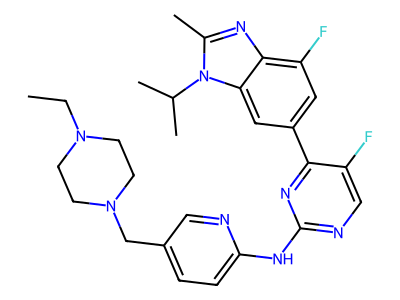
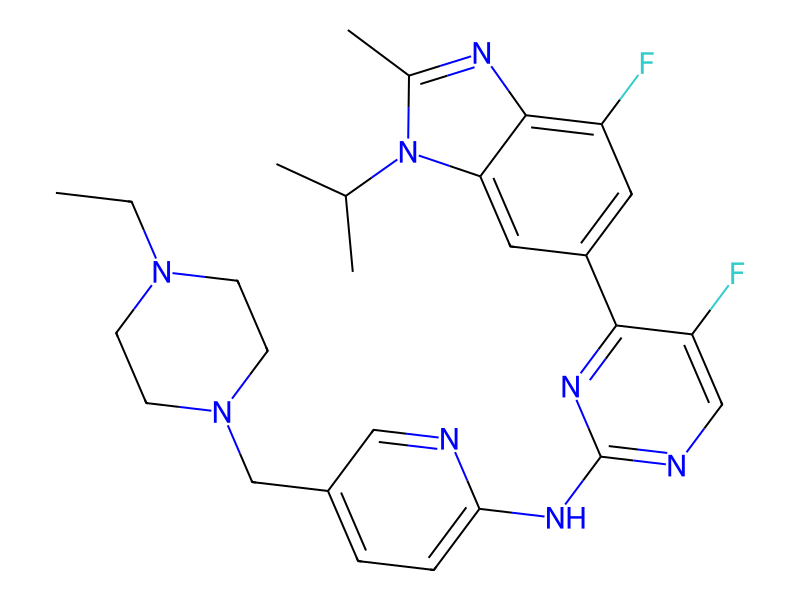
2D構造
Cite this structure
Embed this structure
SMILES
CCN1CCN(Cc2ccc(Nc3ncc(F)c(-c4cc(F)c5nc(C)n(C(C)C)c5c4)n3)nc2)CC1
InChI
InChI=1S/C27H32F2N8/c1-5-35-8-10-36(11-9-35)16-19-6-7-24(30-14-19)33-27-31-15-22(29)25(34-27)20-12-21(28)26-23(13-20)37(17(2)3)18(4)32-26/h6-7,12-15,17H,5,8-11,16H2,1-4H3,(H,30,31,33,34)
Molecular Formula
C27H32F2N8
HBD / HBA
1 / 9
回転可能結合数
7
重原子数
37
No targets recorded
Target interaction data is not yet available for this drug.
No interactions recorded
Drug interaction data is not yet available for this compound.
No side effects recorded
Side effect data is not yet available for this drug.
よくある質問
An oral targeted cancer therapy that blocks proteins called CDK4 and CDK6, which cancer cells rely on to divide and multiply uncontrollably. It is primarily used in combination with hormonal therapies to treat certain types of hormone receptor-positive, HER2-negative breast cancer. Common side effects include diarrhea, which should be treated promptly, as well as low white blood cell counts that increase infection risk.
Selectively inhibits cyclin-dependent kinases 4 and 6 (CDK4/6), blocking the phosphorylation of retinoblastoma protein and arresting the cell cycle at the G1/S transition to prevent cancer cell proliferation.
Yes, Abemaciclib is an approved drug. It has reached clinical phase 4. It is classified as a Small molecule.
References & Data Sources
- ChEMBL — European Bioinformatics Institute (EBI). CHEMBL3301610. Open-access bioactivity database.
- PubChem — National Center for Biotechnology Information (NCBI). CID 46220502. Chemical information database.
Data aggregated from publicly available pharmacological databases. Last updated 2026-08-20.
Embed This Widget
Add the script tag and a data attribute to embed this widget.
<script src="https://cdn.jsdelivr.net/npm/drugfyi-embed@1/dist/embed.min.js" defer></script>
<div data-drugfyi="drug" data-slug="abemaciclib"></div>Embed via iframe for maximum compatibility.
<iframe src="https://drugfyi.com/iframe/drug/abemaciclib/" width="420" height="400" frameborder="0" style="border:0;border-radius:10px;max-width:100%" loading="lazy"></iframe>Paste this URL in WordPress, Medium, or any oEmbed-compatible platform.
https://drugfyi.com/drug/abemaciclib/Add a dynamic SVG badge to your README or docs.
[](https://drugfyi.com/drug/abemaciclib/)Use the native HTML custom element.
<script src="https://cdn.jsdelivr.net/npm/drugfyi-embed@1/dist/embed.min.js" defer></script>
<drugfyi-drug slug="abemaciclib"></drugfyi-drug>