Phenytoin
Controlling seizures through blockade of voltage-gated sodium channels, phenytoin stabilizes those channels in their inactivated form and thereby suppresses the sustained, high-frequency firing that propagates epileptic activity. It is used to prevent and manage several seizure types. What most defines its clinical handling is a narrow therapeutic index: the gap between an effective concentration and a toxic one is small, and its elimination shifts from proportional to saturable as levels rise, so modest dose changes can produce large swings in blood concentration. Regular level monitoring accompanies its use for this reason. A hydantoin small molecule (C15H12N2O2) with a representative half-life near 22 hours, phenytoin is an approved, long-standing antiepileptic that remains important for acute and chronic seizure control.
A medication used to prevent and control seizures in epilepsy by stabilizing the electrical activity in the brain. It requires careful dosing and regular blood level monitoring because the difference between an effective dose and a toxic dose is narrow.
분자량
252.2680 g/mol
LogP
2.50
TPSA
58.20 Ų
리핀스키 5의 법칙
통과
치료 영역
약물 분류
Pharmacokinetics (PK)
Pharmacodynamics (PD)
2D 구조
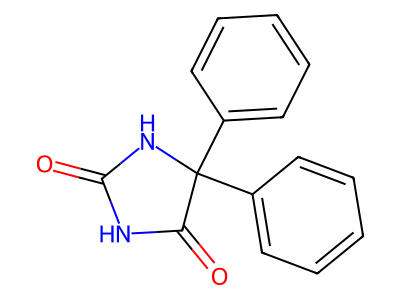
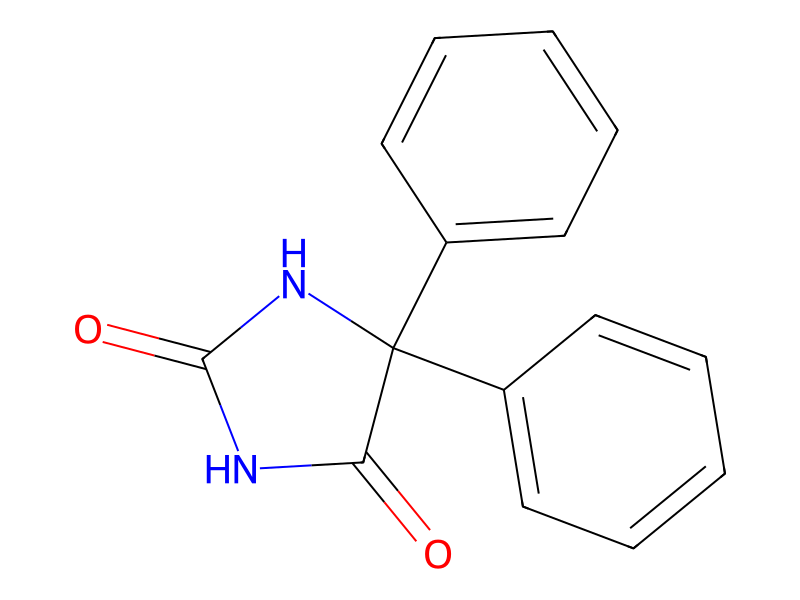
Cite this structure
Embed this structure
SMILES
O=C1NC(=O)C(c2ccccc2)(c2ccccc2)N1
InChI
InChI=1S/C15H12N2O2/c18-13-15(17-14(19)16-13,11-7-3-1-4-8-11)12-9-5-2-6-10-12/h1-10H,(H2,16,17,18,19)
Molecular Formula
C15H12N2O2
HBD / HBA
2 / 2
회전 가능 결합
2
무거운 원자
19
Phenytoin is a strong CYP3A4 inducer that can reduce tacrolimus exposure by more than 50%, putting transplant patients at risk for graft rejection.
Phenytoin drastically reduces quetiapine plasma levels through potent CYP3A4 induction, risking complete loss of antipsychotic effect.
Phenytoin and warfarin have a complex bidirectional interaction: phenytoin initially inhibits warfarin metabolism (raising INR) but then induces it (lowering INR), making anticoagulation management unpredictable.
Ranitidine may slightly increase phenytoin bioavailability through modest inhibition of CYP2C9, though the interaction is less significant than with cimetidine.
Phenytoin reduces topiramate plasma levels via enzyme induction, potentially compromising seizure control when topiramate is added to phenytoin therapy.
Valproic acid displaces phenytoin from protein binding and inhibits its metabolism, leading to increased free phenytoin levels despite total levels that may appear unchanged or decreased.
Phenytoin significantly reduces sertraline plasma concentrations via CYP enzyme induction, potentially causing antidepressant treatment failure.
Phenytoin, a potent CYP inducer, can increase the metabolism of montelukast, potentially reducing its plasma levels and therapeutic efficacy.
Carbamazepine and phenytoin have complex bidirectional interactions that can alter plasma levels of either drug in unpredictable ways.
Acyclovir has been associated with reduced phenytoin plasma concentrations in some patients, potentially compromising seizure control during antiviral therapy.
Phenytoin induces CYP3A4-mediated metabolism of dexamethasone, significantly reducing dexamethasone plasma concentrations and risking loss of efficacy (e.g., in cerebral edema or cancer treatment).
Phenytoin induces hepatic CYP enzymes that increase the formation of acetaminophen's toxic metabolite NAPQI, raising hepatotoxicity risk; conversely, large doses of acetaminophen may transiently reduce phenytoin levels.
No side effects recorded
Side effect data is not yet available for this drug.
자주 묻는 질문
A medication used to prevent and control seizures in epilepsy by stabilizing the electrical activity in the brain. It requires careful dosing and regular blood level monitoring because the difference between an effective dose and a toxic dose is narrow.
Key pharmacokinetic parameters for Phenytoin: Half-life: 22 hours.
Yes, Phenytoin is an approved drug. It has reached clinical phase 4. It is classified as a Small molecule.
Related Drugs
References & Data Sources
- ChEMBL — European Bioinformatics Institute (EBI). CHEMBL16. Open-access bioactivity database.
- PubChem — National Center for Biotechnology Information (NCBI). CID 1775. Chemical information database.
Data aggregated from publicly available pharmacological databases. Last updated 2026-08-20.
Embed This Widget
Add the script tag and a data attribute to embed this widget.
<script src="https://cdn.jsdelivr.net/npm/drugfyi-embed@1/dist/embed.min.js" defer></script>
<div data-drugfyi="drug" data-slug="phenytoin"></div>Embed via iframe for maximum compatibility.
<iframe src="https://drugfyi.com/iframe/drug/phenytoin/" width="420" height="400" frameborder="0" style="border:0;border-radius:10px;max-width:100%" loading="lazy"></iframe>Paste this URL in WordPress, Medium, or any oEmbed-compatible platform.
https://drugfyi.com/drug/phenytoin/Add a dynamic SVG badge to your README or docs.
<a href="https://drugfyi.com/drug/phenytoin/" rel="nofollow noopener"><img src="https://drugfyi.com/badge/entity/phenytoin.svg" alt="DrugFYI"></a>Use the native HTML custom element.
<script src="https://cdn.jsdelivr.net/npm/drugfyi-embed@1/dist/embed.min.js" defer></script>
<drugfyi-drug slug="phenytoin"></drugfyi-drug>