Buformin
An older biguanide antidiabetic drug related to metformin, used to treat type 2 diabetes before being withdrawn from most markets due to an unacceptably high risk of lactic acidosis. It lowered blood sugar by reducing glucose production in the liver and improving insulin sensitivity. It is largely of historical interest in the development of diabetes pharmacology.
Peso Molecular
157,2200 g/mol
LogP
-0,60
TPSA
103,00 Ų
Regra dos 5 de Lipinski
Aprovado
Áreas Terapêuticas
Mecanismo de Ação
Decreases hepatic glucose production, increases insulin sensitivity in peripheral tissues, and reduces intestinal absorption of glucose. The primary mechanism involves activation of AMP-activated protein kinase (AMPK) in hepatocytes.
Pharmacokinetics (PK)
Pharmacodynamics (PD)
Decreases hepatic glucose production, increases insulin sensitivity in peripheral tissues, and reduces intestinal absorption of glucose. The primary mechanism involves activation of AMP-activated protein kinase (AMPK) in hepatocytes.
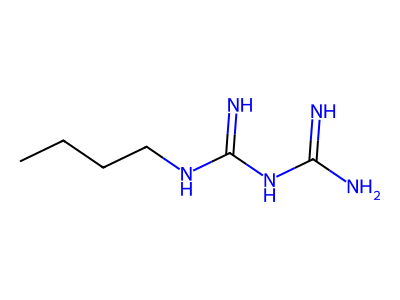
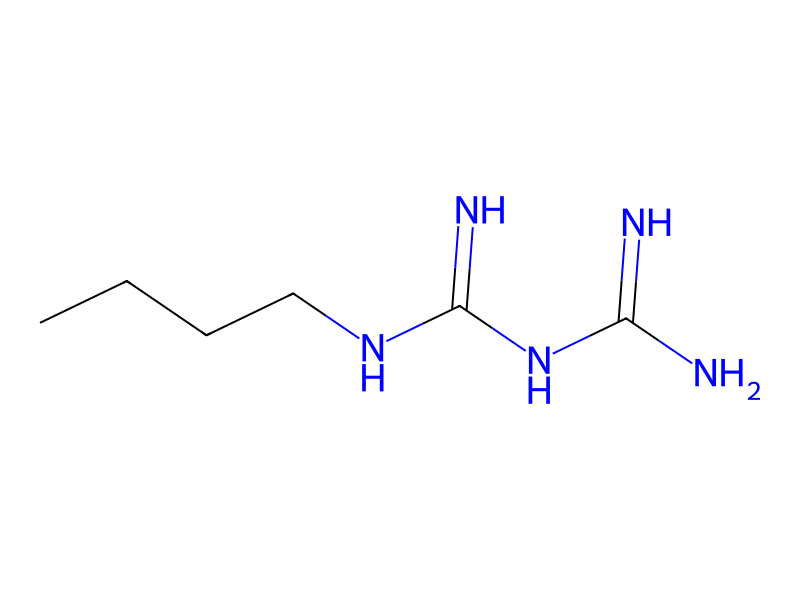
Estrutura 2D
Cite this structure
Embed this structure
SMILES
CCCCNC(=N)NC(=N)N
InChI
InChI=1S/C6H15N5/c1-2-3-4-10-6(9)11-5(7)8/h2-4H2,1H3,(H6,7,8,9,10,11)
Molecular Formula
C6H15N5
HBD / HBA
3 / 1
Ligações Rotacionáveis
4
Átomos Pesados
11
No targets recorded
Target interaction data is not yet available for this drug.
No interactions recorded
Drug interaction data is not yet available for this compound.
No side effects recorded
Side effect data is not yet available for this drug.
Perguntas frequentes
An older biguanide antidiabetic drug related to metformin, used to treat type 2 diabetes before being withdrawn from most markets due to an unacceptably high risk of lactic acidosis. It lowered blood sugar by reducing glucose production in the liver and improving insulin sensitivity. It is largely of historical interest in the development of diabetes pharmacology.
Decreases hepatic glucose production, increases insulin sensitivity in peripheral tissues, and reduces intestinal absorption of glucose. The primary mechanism involves activation of AMP-activated protein kinase (AMPK) in hepatocytes.
Yes, Buformin is an approved drug. It has reached clinical phase 4. It is classified as a Small molecule.
References & Data Sources
- ChEMBL — European Bioinformatics Institute (EBI). CHEMBL39736. Open-access bioactivity database.
- PubChem — National Center for Biotechnology Information (NCBI). CID 2468. Chemical information database.
Data aggregated from publicly available pharmacological databases. Last updated 2026-03-04.
Embed This Widget
Add the script tag and a data attribute to embed this widget.
<script src="https://cdn.jsdelivr.net/npm/drugfyi-embed@1/dist/embed.min.js" defer></script>
<div data-drugfyi="drug" data-slug="buformin"></div>Embed via iframe for maximum compatibility.
<iframe src="https://drugfyi.com/iframe/drug/buformin/" width="420" height="400" frameborder="0" style="border:0;border-radius:10px;max-width:100%" loading="lazy"></iframe>Paste this URL in WordPress, Medium, or any oEmbed-compatible platform.
https://drugfyi.com/drug/buformin/Add a dynamic SVG badge to your README or docs.
[](https://drugfyi.com/drug/buformin/)Use the native HTML custom element.
<script src="https://cdn.jsdelivr.net/npm/drugfyi-embed@1/dist/embed.min.js" defer></script>
<drugfyi-drug slug="buformin"></drugfyi-drug>