Ciprofibrate
A fibrate lipid-lowering agent that activates PPARα nuclear receptors to reduce triglyceride synthesis and increase HDL cholesterol, used in the management of hypertriglyceridemia and mixed dyslipidemia. It has a long half-life allowing once-daily dosing. Myopathy risk is increased, especially in combination with statins.
Peso Molecular
289,1500 g/mol
LogP
3,40
TPSA
46,50 Ų
Regra dos 5 de Lipinski
Aprovado
Áreas Terapêuticas
Pharmacokinetics (PK)
Pharmacodynamics (PD)
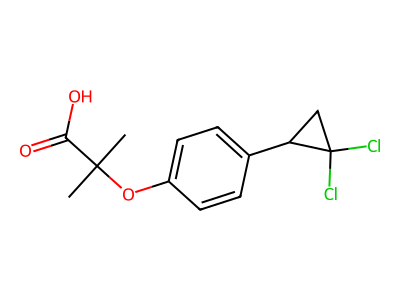
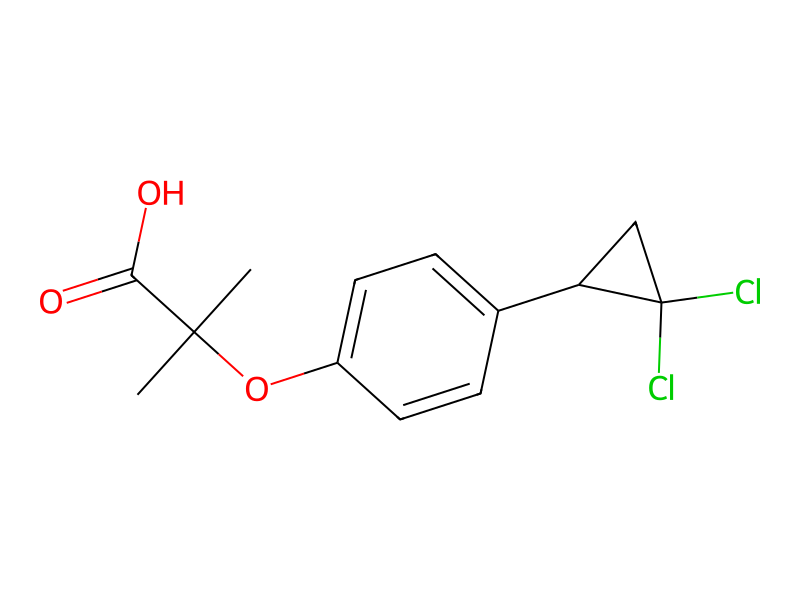
Estrutura 2D
Cite this structure
Embed this structure
SMILES
CC(C)(Oc1ccc(C2CC2(Cl)Cl)cc1)C(=O)O
InChI
InChI=1S/C13H14Cl2O3/c1-12(2,11(16)17)18-9-5-3-8(4-6-9)10-7-13(10,14)15/h3-6,10H,7H2,1-2H3,(H,16,17)
Molecular Formula
C13H14Cl2O3
HBD / HBA
1 / 3
Ligações Rotacionáveis
4
Átomos Pesados
18
No targets recorded
Target interaction data is not yet available for this drug.
No interactions recorded
Drug interaction data is not yet available for this compound.
No side effects recorded
Side effect data is not yet available for this drug.
Perguntas frequentes
A fibrate lipid-lowering agent that activates PPARα nuclear receptors to reduce triglyceride synthesis and increase HDL cholesterol, used in the management of hypertriglyceridemia and mixed dyslipidemia. It has a long half-life allowing once-daily dosing. Myopathy risk is increased, especially in combination with statins.
Yes, Ciprofibrate is an approved drug. It has reached clinical phase 4. It is classified as a Small molecule.
References & Data Sources
- ChEMBL — European Bioinformatics Institute (EBI). CHEMBL557555. Open-access bioactivity database.
- PubChem — National Center for Biotechnology Information (NCBI). CID 2763. Chemical information database.
Data aggregated from publicly available pharmacological databases. Last updated 2026-08-20.
Embed This Widget
Add the script tag and a data attribute to embed this widget.
<script src="https://cdn.jsdelivr.net/npm/drugfyi-embed@1/dist/embed.min.js" defer></script>
<div data-drugfyi="drug" data-slug="ciprofibrate"></div>Embed via iframe for maximum compatibility.
<iframe src="https://drugfyi.com/iframe/drug/ciprofibrate/" width="420" height="400" frameborder="0" style="border:0;border-radius:10px;max-width:100%" loading="lazy"></iframe>Paste this URL in WordPress, Medium, or any oEmbed-compatible platform.
https://drugfyi.com/drug/ciprofibrate/Add a dynamic SVG badge to your README or docs.
[](https://drugfyi.com/drug/ciprofibrate/)Use the native HTML custom element.
<script src="https://cdn.jsdelivr.net/npm/drugfyi-embed@1/dist/embed.min.js" defer></script>
<drugfyi-drug slug="ciprofibrate"></drugfyi-drug>