Dirithromycin
A macrolide antibiotic that is converted in the body to its active form erythromycylamine, used to treat community-acquired pneumonia, bronchitis, and skin infections caused by susceptible bacteria. It works by binding to bacterial ribosomes and inhibiting protein synthesis. It is given once daily and has been largely superseded by newer macrolides like azithromycin and clarithromycin.
Peso Molecular
835,1000 g/mol
LogP
4,20
TPSA
196,00 Ų
Regra dos 5 de Lipinski
Reprovado
Áreas Terapêuticas
Mecanismo de Ação
Binds to the 50S ribosomal subunit of susceptible bacteria, blocking the translocation step of protein synthesis by interfering with transpeptidation and translocation. This results in bacteriostatic inhibition of protein production.
Pharmacokinetics (PK)
Pharmacodynamics (PD)
Binds to the 50S ribosomal subunit of susceptible bacteria, blocking the translocation step of protein synthesis by interfering with transpeptidation and translocation. This results in bacteriostatic inhibition of protein production.
Estrutura 2D
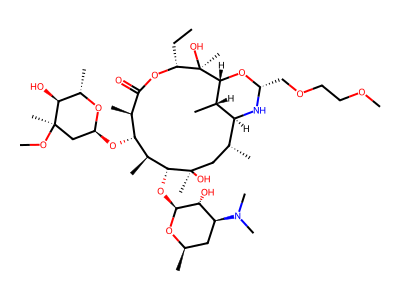
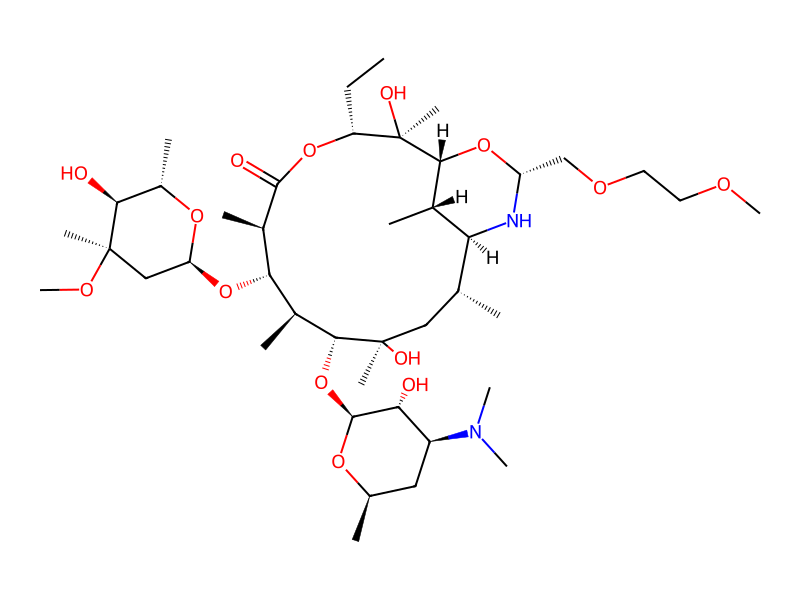
Cite this structure
Embed this structure
SMILES
CC[C@H]1OC(=O)[C@H](C)[C@@H](O[C@H]2C[C@@](C)(OC)[C@@H](O)[C@H](C)O2)[C@H](C)[C@@H](O[C@@H]2O[C@H](C)C[C@H](N(C)C)[C@H]2O)[C@](C)(O)C[C@@H](C)[C@@H]2N[C@@H](COCCOC)O[C@H]([C@H]2C)[C@]1(C)O
InChI
InChI=1S/C42H78N2O14/c1-15-29-42(10,49)37-24(4)32(43-30(56-37)21-52-17-16-50-13)22(2)19-40(8,48)36(58-39-33(45)28(44(11)12)18-23(3)53-39)25(5)34(26(6)38(47)55-29)57-31-20-41(9,51-14)35(46)27(7)54-31/h22-37,39,43,45-46,48-49H,15-21H2,1-14H3/t22-,23-,24+,25+,26-,27+,28+,29-,30-,31+,32+,33-,34+,35+,36-,37-,39+,40-,41-,42-/m1/s1
Molecular Formula
C42H78N2O14
HBD / HBA
5 / 16
Ligações Rotacionáveis
12
Átomos Pesados
58
No targets recorded
Target interaction data is not yet available for this drug.
No interactions recorded
Drug interaction data is not yet available for this compound.
No side effects recorded
Side effect data is not yet available for this drug.
Perguntas frequentes
A macrolide antibiotic that is converted in the body to its active form erythromycylamine, used to treat community-acquired pneumonia, bronchitis, and skin infections caused by susceptible bacteria. It works by binding to bacterial ribosomes and inhibiting protein synthesis. It is given once daily and has been largely superseded by newer macrolides like azithromycin and clarithromycin.
Binds to the 50S ribosomal subunit of susceptible bacteria, blocking the translocation step of protein synthesis by interfering with transpeptidation and translocation. This results in bacteriostatic inhibition of protein production.
Yes, Dirithromycin is an approved drug. It has reached clinical phase 4. It is classified as a Small molecule.
References & Data Sources
- ChEMBL — European Bioinformatics Institute (EBI). CHEMBL1237072. Open-access bioactivity database.
- PubChem — National Center for Biotechnology Information (NCBI). CID 6473883. Chemical information database.
Data aggregated from publicly available pharmacological databases. Last updated 2026-03-04.
Embed This Widget
Add the script tag and a data attribute to embed this widget.
<script src="https://cdn.jsdelivr.net/npm/drugfyi-embed@1/dist/embed.min.js" defer></script>
<div data-drugfyi="drug" data-slug="dirithromycin"></div>Embed via iframe for maximum compatibility.
<iframe src="https://drugfyi.com/iframe/drug/dirithromycin/" width="420" height="400" frameborder="0" style="border:0;border-radius:10px;max-width:100%" loading="lazy"></iframe>Paste this URL in WordPress, Medium, or any oEmbed-compatible platform.
https://drugfyi.com/drug/dirithromycin/Add a dynamic SVG badge to your README or docs.
<a href="https://drugfyi.com/drug/dirithromycin/" rel="nofollow noopener"><img src="https://drugfyi.com/badge/entity/dirithromycin.svg" alt="DrugFYI"></a>Use the native HTML custom element.
<script src="https://cdn.jsdelivr.net/npm/drugfyi-embed@1/dist/embed.min.js" defer></script>
<drugfyi-drug slug="dirithromycin"></drugfyi-drug>