Orphenadrine
Two distinct pharmacological actions converge in orphenadrine: skeletal muscle relaxation and anticholinergic activity. The relaxant effect reduces muscle tone and spasm through central modulation of spinal reflex pathways rather than direct action on the muscle fibre, which separates it from peripherally acting neuromuscular blockers. Anticholinergic activity accounts for its application to the rigidity of Parkinson's disease as well as for the dry mouth and related effects characteristic of the class. Clinical use accordingly spans musculoskeletal pain with spasm and parkinsonian rigidity. The molecule is a small molecule with formula C18H23NO and a molecular weight of about 269.4 g/mol, approved and carried through the final phase of clinical development.
A muscle relaxant and anticholinergic for muscle pain, spasms, and Parkinson's-related rigidity.
Peso Molecular
269,4000 g/mol
LogP
3,80
TPSA
12,50 Ų
Regra dos 5 de Lipinski
Aprovado
Mecanismo de Ação
A centrally acting muscle relaxant with anticholinergic and NMDA-receptor antagonist activity. Orphenadrine lowers muscle tone through central mechanisms rather than by acting on skeletal muscle directly; its antimuscarinic activity accounts for the effect on parkinsonian rigidity and tremor as well as for dry mouth and urinary retention.
Pharmacokinetics (PK)
Pharmacodynamics (PD)
A centrally acting muscle relaxant with anticholinergic and NMDA-receptor antagonist activity. Orphenadrine lowers muscle tone through central mechanisms rather than by acting on skeletal muscle directly; its antimuscarinic activity accounts …
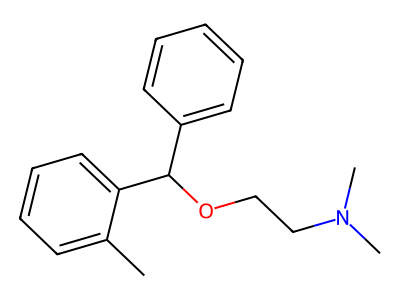
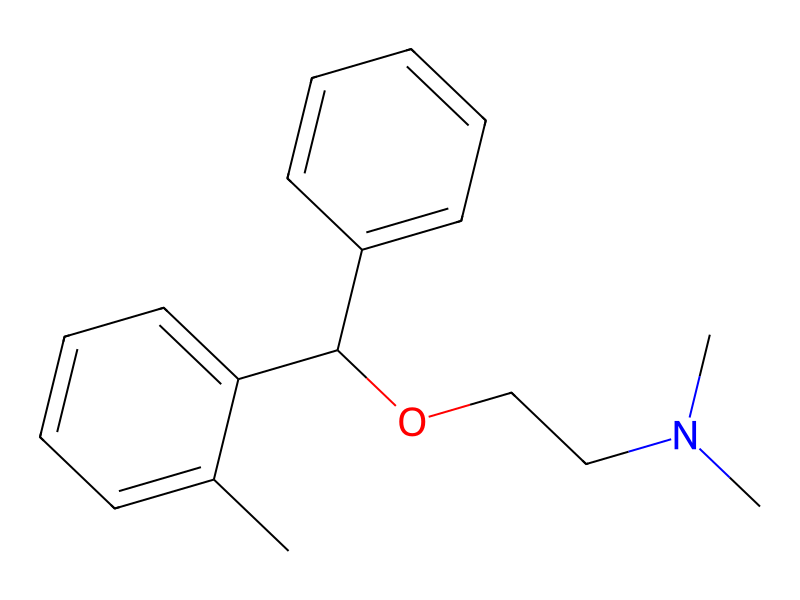
Estrutura 2D
Cite this structure
Embed this structure
SMILES
Cc1ccccc1C(OCCN(C)C)c1ccccc1
InChI
InChI=1S/C18H23NO/c1-15-9-7-8-12-17(15)18(20-14-13-19(2)3)16-10-5-4-6-11-16/h4-12,18H,13-14H2,1-3H3
Molecular Formula
C18H23NO
HBD / HBA
- / 2
Ligações Rotacionáveis
6
Átomos Pesados
20
No targets recorded
Target interaction data is not yet available for this drug.
No interactions recorded
Drug interaction data is not yet available for this compound.
No side effects recorded
Side effect data is not yet available for this drug.
Perguntas frequentes
A muscle relaxant and anticholinergic for muscle pain, spasms, and Parkinson's-related rigidity.
A centrally acting muscle relaxant with anticholinergic and NMDA-receptor antagonist activity. Orphenadrine lowers muscle tone through central mechanisms rather than by acting on skeletal muscle directly; its antimuscarinic activity accounts for the effect on parkinsonian rigidity and tremor as well as for dry mouth and urinary retention.
Yes, Orphenadrine is an approved drug. It has reached clinical phase 4. It is classified as a Small molecule.
References & Data Sources
- ChEMBL — European Bioinformatics Institute (EBI). CHEMBL900. Open-access bioactivity database.
- PubChem — National Center for Biotechnology Information (NCBI). CID 4601. Chemical information database.
Data aggregated from publicly available pharmacological databases. Last updated 2026-08-20.
Embed This Widget
Add the script tag and a data attribute to embed this widget.
<script src="https://cdn.jsdelivr.net/npm/drugfyi-embed@1/dist/embed.min.js" defer></script>
<div data-drugfyi="drug" data-slug="orphenadrine"></div>Embed via iframe for maximum compatibility.
<iframe src="https://drugfyi.com/iframe/drug/orphenadrine/" width="420" height="400" frameborder="0" style="border:0;border-radius:10px;max-width:100%" loading="lazy"></iframe>Paste this URL in WordPress, Medium, or any oEmbed-compatible platform.
https://drugfyi.com/drug/orphenadrine/Add a dynamic SVG badge to your README or docs.
[](https://drugfyi.com/drug/orphenadrine/)Use the native HTML custom element.
<script src="https://cdn.jsdelivr.net/npm/drugfyi-embed@1/dist/embed.min.js" defer></script>
<drugfyi-drug slug="orphenadrine"></drugfyi-drug>