Fluconazole
By inhibiting the fungal enzyme CYP51, also called lanosterol 14-alpha-demethylase, fluconazole halts the synthesis of ergosterol, a sterol the fungal cell membrane depends on. The depleted membrane becomes leaky and the organism dies, giving this triazole antifungal its activity against yeasts and related pathogens. It is used for infections ranging from oral and vaginal thrush to systemic candidiasis and cryptococcal meningitis. A fluorinated small molecule (C13H12F2N6O) with a long half-life near 30 hours, it supports once-daily dosing and good tissue penetration. Because human sterol enzymes are far less sensitive to its action than the fungal target, fluconazole achieves selective toxicity, a property central to modern antifungal therapy. It is an approved agent widely used in both hospital and outpatient care.
This antifungal medication works by blocking the production of ergosterol, an essential component of the fungal cell membrane, causing the organism to die. It is widely used to treat fungal infections including thrush, cryptococcal meningitis, and systemic candida infections.
Молекулярная масса
306,2710 g/mol
LogP
0,40
TPSA
81,70 Ų
Правило пяти Липинского
Соответствует
Терапевтические области
Классы препаратов
Механизм действия
Inhibits fungal CYP51 (lanosterol 14-alpha-demethylase).
Pharmacokinetics (PK)
Pharmacodynamics (PD)
Inhibits fungal CYP51 (lanosterol 14-alpha-demethylase).
2D Структура
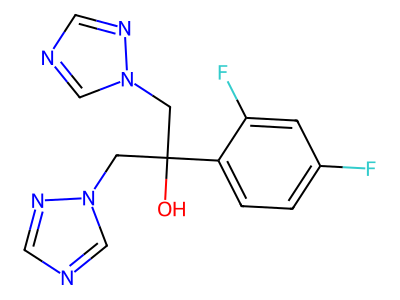
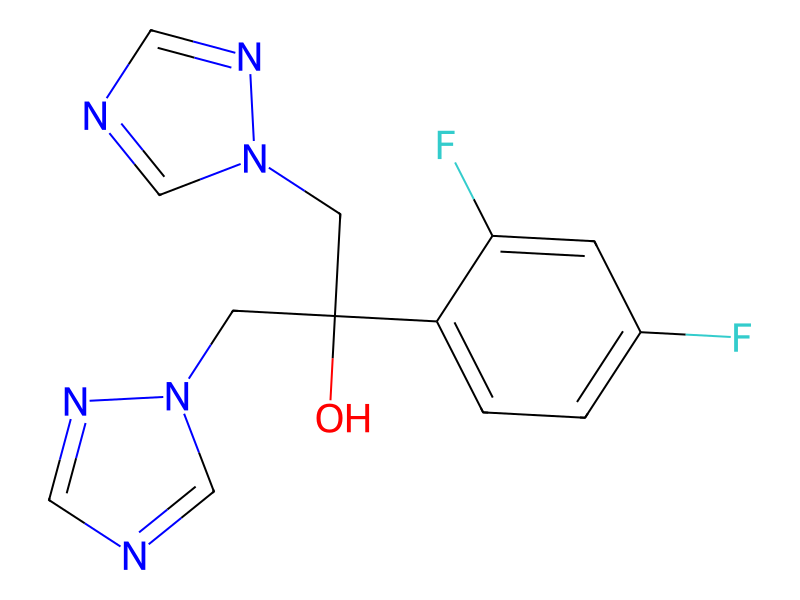
Cite this structure
Embed this structure
SMILES
OC(Cn1cncn1)(Cn1cncn1)c1ccc(F)cc1F
InChI
InChI=1S/C13H12F2N6O/c14-10-1-2-11(12(15)3-10)13(22,4-20-8-16-6-18-20)5-21-9-17-7-19-21/h1-3,6-9,22H,4-5H2
Molecular Formula
C13H12F2N6O
HBD / HBA
1 / 7
Вращаемые Связи
5
Тяжёлые Атомы
22
Fluconazole markedly increases rivaroxaban exposure through dual inhibition of CYP3A4 and P-glycoprotein, substantially elevating bleeding risk.
Fluconazole substantially increases quetiapine plasma concentrations via CYP3A4 inhibition, raising the risk of quetiapine-mediated QT prolongation and torsades de pointes.
Fluconazole inhibits the metabolism of ondansetron and both drugs prolong the QT interval, creating a compounded arrhythmia risk.
Fluconazole inhibits hydroxychloroquine metabolism and both drugs prolong the QT interval, creating compounded arrhythmia risk.
Fluconazole dramatically increases warfarin exposure, causing large INR elevations and a high risk of serious or life-threatening bleeding.
Fluconazole markedly inhibits CYP3A4-mediated tacrolimus metabolism, causing 2- to 4-fold elevations in tacrolimus trough levels and substantial risk of nephrotoxicity and neurotoxicity.
Fluconazole inhibits CYP3A4-mediated metabolism of loratadine, modestly increasing loratadine plasma concentrations; however, loratadine's poor CNS penetration limits the clinical consequence.
Fluconazole has minimal effect on pravastatin exposure because pravastatin is not significantly metabolised by CYP enzymes; the interaction is pharmacokinetically unimportant in most patients.
Fluconazole inhibits CYP2C8-mediated metabolism of montelukast, modestly increasing montelukast plasma concentrations; the clinical impact is generally minor given montelukast's wide therapeutic index.
Fluconazole inhibits CYP3A4-mediated metabolism of methylprednisolone, increasing its plasma levels and prolonging corticosteroid effects, raising the risk of Cushingoid features.
Fluconazole inhibits CYP3A4-mediated tamsulosin metabolism, substantially increasing tamsulosin exposure and the risk of hypotension and syncope.
Fluconazole inhibits CYP2C19 and CYP3A4, increasing sertraline plasma concentrations, which may enhance both therapeutic and adverse effects including QT prolongation.
Fluconazole increases apixaban plasma concentrations significantly through dual CYP3A4 and P-gp inhibition, raising bleeding risk.
Fluconazole inhibits CYP3A4, which contributes to finasteride metabolism; co-administration may modestly increase finasteride plasma concentrations, though the clinical significance is generally low.
Fluconazole inhibits CYP3A4 and CYP2C19, increasing aripiprazole plasma concentrations and the risk of aripiprazole adverse effects.
Fluconazole inhibits CYP3A4, reducing dexamethasone clearance and raising dexamethasone plasma levels, potentially causing Cushingoid features or adrenal suppression on steroid withdrawal.
No side effects recorded
Side effect data is not yet available for this drug.
Часто задаваемые вопросы
This antifungal medication works by blocking the production of ergosterol, an essential component of the fungal cell membrane, causing the organism to die. It is widely used to treat fungal infections including thrush, cryptococcal meningitis, and systemic candida infections.
Inhibits fungal CYP51 (lanosterol 14-alpha-demethylase).
Key pharmacokinetic parameters for Fluconazole: Half-life: 30 hours.
Yes, Fluconazole is an approved drug. It has reached clinical phase 4. It is classified as a Small molecule.
Related Drugs
References & Data Sources
- ChEMBL — European Bioinformatics Institute (EBI). CHEMBL106. Open-access bioactivity database.
- PubChem — National Center for Biotechnology Information (NCBI). CID 3365. Chemical information database.
Data aggregated from publicly available pharmacological databases. Last updated 2026-03-04.
Медицинский отказ от ответственности
This content is for educational and informational purposes only. It is not a substitute for professional medical advice, diagnosis, or treatment. Always consult a qualified healthcare provider before making medication decisions.
Embed This Widget
Add the script tag and a data attribute to embed this widget.
<script src="https://cdn.jsdelivr.net/npm/drugfyi-embed@1/dist/embed.min.js" defer></script>
<div data-drugfyi="drug" data-slug="fluconazole"></div>Embed via iframe for maximum compatibility.
<iframe src="https://drugfyi.com/iframe/drug/fluconazole/" width="420" height="400" frameborder="0" style="border:0;border-radius:10px;max-width:100%" loading="lazy"></iframe>Paste this URL in WordPress, Medium, or any oEmbed-compatible platform.
https://drugfyi.com/drug/fluconazole/Add a dynamic SVG badge to your README or docs.
[](https://drugfyi.com/drug/fluconazole/)Use the native HTML custom element.
<script src="https://cdn.jsdelivr.net/npm/drugfyi-embed@1/dist/embed.min.js" defer></script>
<drugfyi-drug slug="fluconazole"></drugfyi-drug>