Colchicine
A plant-derived compound used since antiquity, colchicine binds tubulin and disrupts microtubule assembly in neutrophils, blunting the inflammatory response. It is highly effective for treating and preventing gout attacks and pericarditis, and at low doses has been shown to reduce cardiovascular events in coronary artery disease. Marketed as Colcrys and Mitigare, the alkaloid has the formula C22H25NO6. Its narrow therapeutic margin makes careful dosing essential.
An ancient plant-derived drug that disrupts microtubule formation in neutrophils, making it highly effective for treating and preventing gout attacks and pericarditis. At low doses it has been shown to reduce cardiovascular events in patients with coronary artery disease.
น้ำหนักโมเลกุล
399.4370 g/mol
LogP
1.00
TPSA
83.10 Ų
Lipinski RO5
ผ่าน
ด้านการรักษา
หมวดหมู่ยา
กลไกการออกฤทธิ์
Binds tubulin disrupting microtubule polymerization; anti-inflammatory.
Pharmacokinetics (PK)
Pharmacodynamics (PD)
Binds tubulin disrupting microtubule polymerization; anti-inflammatory.
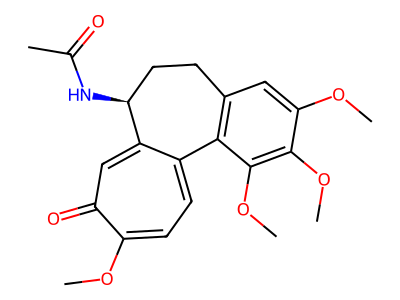
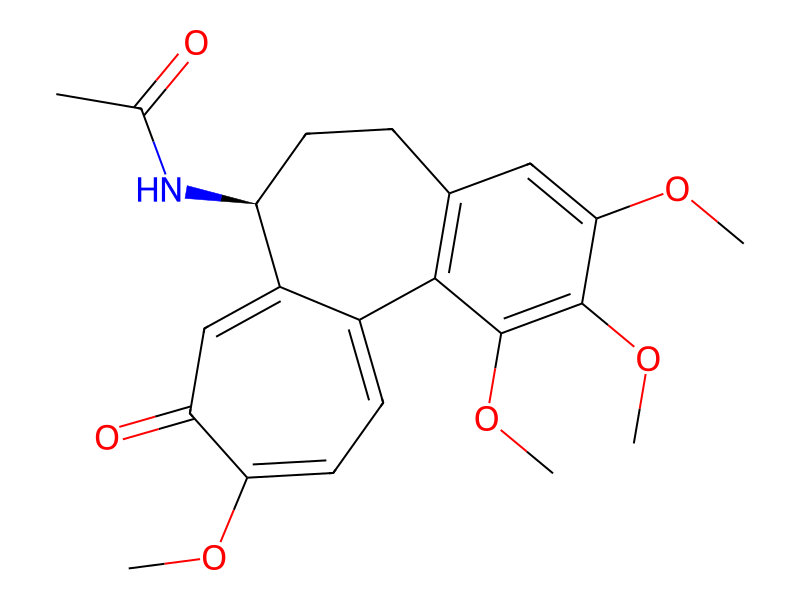
โครงสร้าง 2 มิติ
Cite this structure
Embed this structure
SMILES
COc1cc2c(c(OC)c1OC)-c1ccc(OC)c(=O)cc1[C@@H](NC(C)=O)CC2
InChI
InChI=1S/C22H25NO6/c1-12(24)23-16-8-6-13-10-19(27-3)21(28-4)22(29-5)20(13)14-7-9-18(26-2)17(25)11-15(14)16/h7,9-11,16H,6,8H2,1-5H3,(H,23,24)/t16-/m0/s1
Molecular Formula
C22H25NO6
HBD / HBA
1 / 6
พันธะที่หมุนได้
5
อะตอมหนัก
29
Concurrent use of colchicine and pravastatin carries a small theoretical risk of myopathy, as both drugs individually can cause muscle toxicity, though the combination is better tolerated than colchicine with …
Rosuvastatin and colchicine share BCRP transporter-mediated elimination; colchicine may weakly increase rosuvastatin exposure, and both carry myotoxic potential that could be additive.
Colchicine may increase bleeding risk when combined with warfarin; isolated case reports suggest possible INR elevation, though the mechanism is not well characterized.
Azithromycin inhibits P-glycoprotein and CYP3A4-mediated metabolism of colchicine, increasing colchicine plasma concentrations and the risk of colchicine toxicity, including neuromuscular and gastrointestinal toxicity.
No side effects recorded
Side effect data is not yet available for this drug.
คำถามที่พบบ่อย
An ancient plant-derived drug that disrupts microtubule formation in neutrophils, making it highly effective for treating and preventing gout attacks and pericarditis. At low doses it has been shown to reduce cardiovascular events in patients with coronary artery disease.
Binds tubulin disrupting microtubule polymerization; anti-inflammatory.
Key pharmacokinetic parameters for Colchicine: Half-life: 26-31 hours.
Yes, Colchicine is an approved drug. It has reached clinical phase 4. It is classified as a Small molecule.
Related Drugs
References & Data Sources
- ChEMBL — European Bioinformatics Institute (EBI). CHEMBL107. Open-access bioactivity database.
- PubChem — National Center for Biotechnology Information (NCBI). CID 6167. Chemical information database.
Data aggregated from publicly available pharmacological databases. Last updated 2026-03-04.
ข้อจำกัดความรับผิดชอบทางการแพทย์
This content is for educational and informational purposes only. It is not a substitute for professional medical advice, diagnosis, or treatment. Always consult a qualified healthcare provider before making medication decisions.
Embed This Widget
Add the script tag and a data attribute to embed this widget.
<script src="https://cdn.jsdelivr.net/npm/drugfyi-embed@1/dist/embed.min.js" defer></script>
<div data-drugfyi="drug" data-slug="colchicine"></div>Embed via iframe for maximum compatibility.
<iframe src="https://drugfyi.com/iframe/drug/colchicine/" width="420" height="400" frameborder="0" style="border:0;border-radius:10px;max-width:100%" loading="lazy"></iframe>Paste this URL in WordPress, Medium, or any oEmbed-compatible platform.
https://drugfyi.com/drug/colchicine/Add a dynamic SVG badge to your README or docs.
[](https://drugfyi.com/drug/colchicine/)Use the native HTML custom element.
<script src="https://cdn.jsdelivr.net/npm/drugfyi-embed@1/dist/embed.min.js" defer></script>
<drugfyi-drug slug="colchicine"></drugfyi-drug>