Minodronic Acid
This bisphosphonate medication is used in Japan to treat osteoporosis by inhibiting osteoclast activity, the cells responsible for breaking down bone, thereby slowing bone loss and reducing fracture risk. Like other bisphosphonates, it is taken orally and builds up preferentially in bone tissue.
Khối lượng phân tử
322,1500 g/mol
LogP
-2,20
TPSA
153,00 Ų
Lipinski RO5
Đạt
Lĩnh vực điều trị
Cơ chế tác dụng
Binds to hydroxyapatite crystals in bone, inhibiting osteoclast-mediated bone resorption by disrupting the mevalonate pathway within osteoclasts. This reduces bone turnover and increases bone mineral density.
Pharmacokinetics (PK)
Pharmacodynamics (PD)
Binds to hydroxyapatite crystals in bone, inhibiting osteoclast-mediated bone resorption by disrupting the mevalonate pathway within osteoclasts. This reduces bone turnover and increases bone mineral density.
Cấu trúc 2D
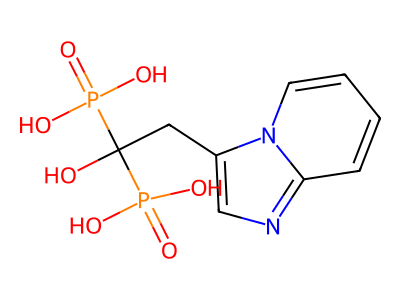
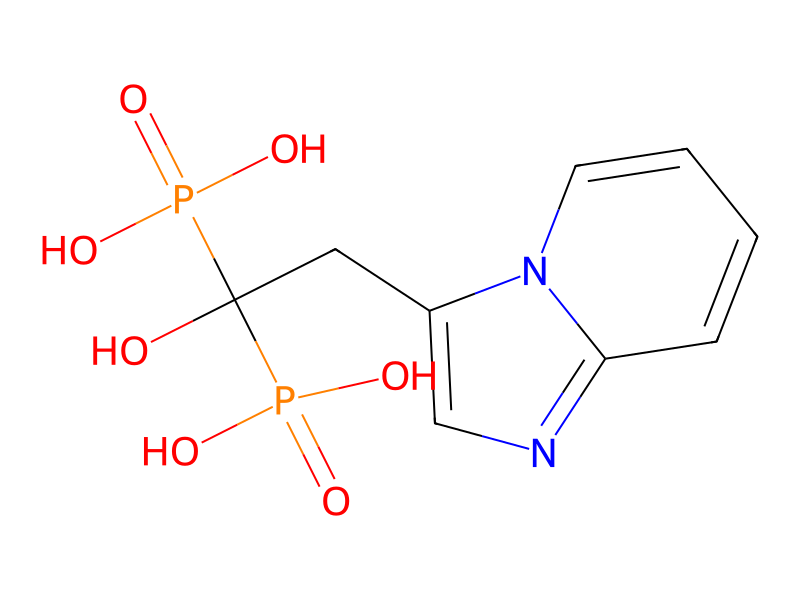
Cite this structure
Embed this structure
SMILES
O=P(O)(O)C(O)(Cc1cnc2ccccn12)P(=O)(O)O
InChI
InChI=1S/C9H12N2O7P2/c12-9(19(13,14)15,20(16,17)18)5-7-6-10-8-3-1-2-4-11(7)8/h1-4,6,12H,5H2,(H2,13,14,15)(H2,16,17,18)
Molecular Formula
C9H12N2O7P2
HBD / HBA
5 / 8
Liên kết có thể quay
4
Nguyên tử nặng
20
No targets recorded
Target interaction data is not yet available for this drug.
No interactions recorded
Drug interaction data is not yet available for this compound.
No side effects recorded
Side effect data is not yet available for this drug.
Câu hỏi thường gặp
This bisphosphonate medication is used in Japan to treat osteoporosis by inhibiting osteoclast activity, the cells responsible for breaking down bone, thereby slowing bone loss and reducing fracture risk. Like other bisphosphonates, it is taken orally and builds up preferentially in bone tissue.
Binds to hydroxyapatite crystals in bone, inhibiting osteoclast-mediated bone resorption by disrupting the mevalonate pathway within osteoclasts. This reduces bone turnover and increases bone mineral density.
Yes, Minodronic Acid is an approved drug. It has reached clinical phase 4. It is classified as a Small molecule.
References & Data Sources
- ChEMBL — European Bioinformatics Institute (EBI). CHEMBL319144. Open-access bioactivity database.
- PubChem — National Center for Biotechnology Information (NCBI). CID 130956. Chemical information database.
Data aggregated from publicly available pharmacological databases. Last updated 2026-03-28.
Embed This Widget
Add the script tag and a data attribute to embed this widget.
<script src="https://cdn.jsdelivr.net/npm/drugfyi-embed@1/dist/embed.min.js" defer></script>
<div data-drugfyi="drug" data-slug="minodronic-acid"></div>Embed via iframe for maximum compatibility.
<iframe src="https://drugfyi.com/iframe/drug/minodronic-acid/" width="420" height="400" frameborder="0" style="border:0;border-radius:10px;max-width:100%" loading="lazy"></iframe>Paste this URL in WordPress, Medium, or any oEmbed-compatible platform.
https://drugfyi.com/drug/minodronic-acid/Add a dynamic SVG badge to your README or docs.
[](https://drugfyi.com/drug/minodronic-acid/)Use the native HTML custom element.
<script src="https://cdn.jsdelivr.net/npm/drugfyi-embed@1/dist/embed.min.js" defer></script>
<drugfyi-drug slug="minodronic-acid"></drugfyi-drug>