Cephalothin
A first-generation parenteral cephalosporin antibiotic that inhibits cell wall synthesis, historically used for gram-positive infections including staphylococcal infections before the emergence of MRSA. It was one of the first cephalosporins available but is now largely obsolete in clinical practice. It has been replaced by safer and more effective agents.
分子量
396.4000 g/mol
LogP
-0.40
TPSA
167.00 Ų
Lipinski 五规则
符合
治疗领域
作用机制
Disrupts bacterial cell wall synthesis by binding to penicillin-binding proteins (PBPs), inhibiting the final transpeptidation step of peptidoglycan synthesis. The resulting cell wall defects cause osmotic instability and bacteriolysis.
Pharmacokinetics (PK)
Pharmacodynamics (PD)
Disrupts bacterial cell wall synthesis by binding to penicillin-binding proteins (PBPs), inhibiting the final transpeptidation step of peptidoglycan synthesis. The resulting cell wall defects cause osmotic instability and bacteriolysis.
二维结构
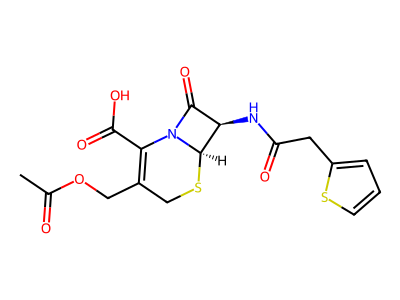
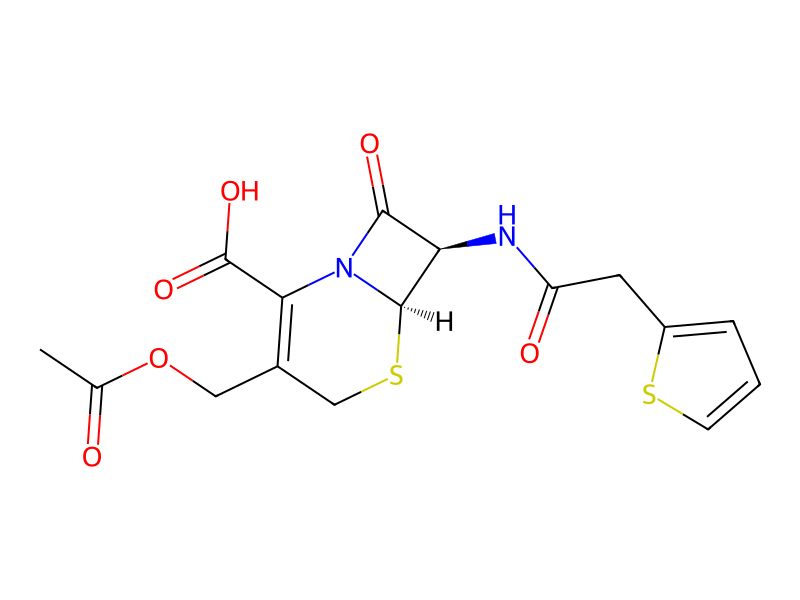
Cite this structure
Embed this structure
SMILES
CC(=O)OCC1=C(C(=O)O)N2C(=O)[C@@H](NC(=O)Cc3cccs3)[C@H]2SC1
InChI
InChI=1S/C16H16N2O6S2/c1-8(19)24-6-9-7-26-15-12(14(21)18(15)13(9)16(22)23)17-11(20)5-10-3-2-4-25-10/h2-4,12,15H,5-7H2,1H3,(H,17,20)(H,22,23)/t12-,15-/m1/s1
Molecular Formula
C16H16N2O6S2
HBD / HBA
2 / 8
可旋转键数
7
重原子数
26
No targets recorded
Target interaction data is not yet available for this drug.
No interactions recorded
Drug interaction data is not yet available for this compound.
No side effects recorded
Side effect data is not yet available for this drug.
常见问题
A first-generation parenteral cephalosporin antibiotic that inhibits cell wall synthesis, historically used for gram-positive infections including staphylococcal infections before the emergence of MRSA. It was one of the first cephalosporins available but is now largely obsolete in clinical practice. It has been replaced by safer and more effective agents.
Disrupts bacterial cell wall synthesis by binding to penicillin-binding proteins (PBPs), inhibiting the final transpeptidation step of peptidoglycan synthesis. The resulting cell wall defects cause osmotic instability and bacteriolysis.
Yes, Cephalothin is an approved drug. It has reached clinical phase 4. It is classified as a Small molecule.
References & Data Sources
- ChEMBL — European Bioinformatics Institute (EBI). CHEMBL617. Open-access bioactivity database.
- PubChem — National Center for Biotechnology Information (NCBI). CID 6024. Chemical information database.
Data aggregated from publicly available pharmacological databases. Last updated 2026-03-04.
Embed This Widget
Add the script tag and a data attribute to embed this widget.
<script src="https://cdn.jsdelivr.net/npm/drugfyi-embed@1/dist/embed.min.js" defer></script>
<div data-drugfyi="drug" data-slug="cephalothin"></div>Embed via iframe for maximum compatibility.
<iframe src="https://drugfyi.com/iframe/drug/cephalothin/" width="420" height="400" frameborder="0" style="border:0;border-radius:10px;max-width:100%" loading="lazy"></iframe>Paste this URL in WordPress, Medium, or any oEmbed-compatible platform.
https://drugfyi.com/drug/cephalothin/Add a dynamic SVG badge to your README or docs.
[](https://drugfyi.com/drug/cephalothin/)Use the native HTML custom element.
<script src="https://cdn.jsdelivr.net/npm/drugfyi-embed@1/dist/embed.min.js" defer></script>
<drugfyi-drug slug="cephalothin"></drugfyi-drug>