Hydroxychloroquine
An antimalarial repurposed for autoimmune disease, hydroxychloroquine now treats rheumatoid arthritis, lupus, and Sjögren's syndrome more often than the parasitic infection it was designed for. It accumulates inside lysosomes and raises their internal pH, which interferes with antigen processing and dampens toll-like receptor signaling, reducing the output of inflammatory cytokines. A small molecule (C18H26ClN3O), it is remarkable for an extraordinarily long half-life of roughly 40 to 50 days, so it builds up slowly and clears just as slowly from the body. That prolonged retention, together with a tendency to deposit in the retina, is why periodic eye examinations accompany long-term use. Hydroxychloroquine is an approved medicine central to the management of several autoimmune conditions.
Originally developed as an antimalarial drug, this medication is widely used to treat autoimmune diseases including rheumatoid arthritis, lupus, and Sjögren's syndrome. It modulates the immune system by interfering with antigen processing and reducing the production of inflammatory cytokines. Regular eye examinations are recommended during long-term use due to a risk of retinal damage.
分子量
335.8720 g/mol
LogP
3.60
TPSA
48.40 Ų
Lipinski 五规则
符合
治疗领域
药物分类
作用机制
Accumulates in lysosomes raising pH; inhibits toll-like receptor signaling.
Pharmacokinetics (PK)
Pharmacodynamics (PD)
Accumulates in lysosomes raising pH; inhibits toll-like receptor signaling.
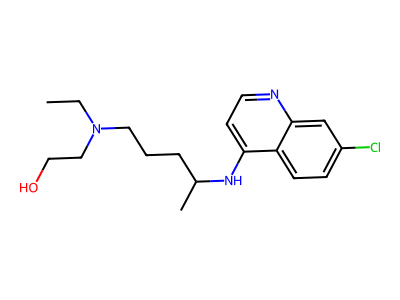
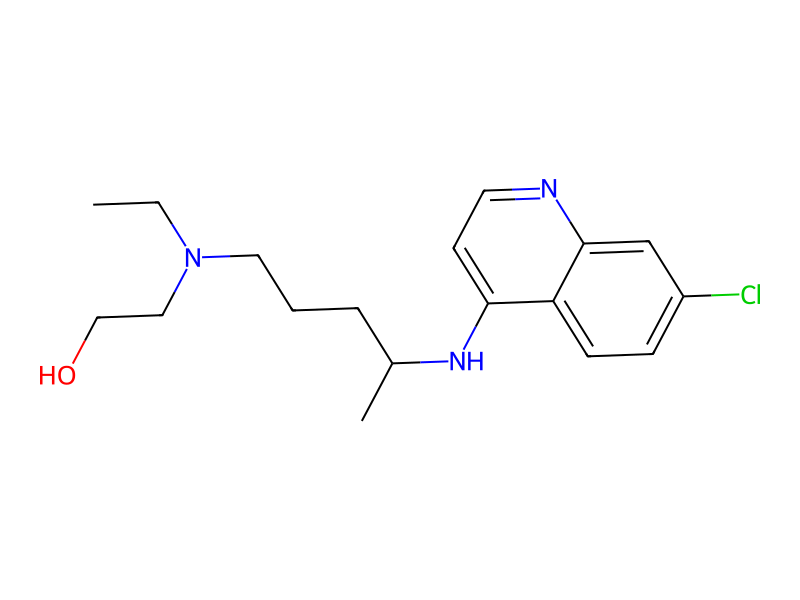
二维结构
Cite this structure
Embed this structure
SMILES
CCN(CCO)CCCC(C)Nc1ccnc2cc(Cl)ccc12
InChI
InChI=1S/C18H26ClN3O/c1-3-22(11-12-23)10-4-5-14(2)21-17-8-9-20-18-13-15(19)6-7-16(17)18/h6-9,13-14,23H,3-5,10-12H2,1-2H3,(H,20,21)
Molecular Formula
C18H26ClN3O
HBD / HBA
2 / 4
可旋转键数
9
重原子数
23
No targets recorded
Target interaction data is not yet available for this drug.
Hydroxychloroquine and ondansetron both prolong cardiac repolarization via hERG blockade; concurrent use substantially elevates arrhythmia risk.
Hydroxychloroquine has intrinsic insulin-sensitising properties that may augment the glucose-lowering effect of metformin, occasionally producing hypoglycaemia.
Hydroxychloroquine may potentiate the anticoagulant effect of warfarin, raising INR and the risk of bleeding complications.
Both azithromycin and hydroxychloroquine independently prolong the cardiac QT interval; concurrent use substantially raises the risk of torsades de pointes and sudden cardiac death.
Both escitalopram and hydroxychloroquine prolong the QT interval; their concurrent use markedly increases the risk of potentially fatal arrhythmias.
Fluconazole inhibits hydroxychloroquine metabolism and both drugs prolong the QT interval, creating compounded arrhythmia risk.
No side effects recorded
Side effect data is not yet available for this drug.
常见问题
Originally developed as an antimalarial drug, this medication is widely used to treat autoimmune diseases including rheumatoid arthritis, lupus, and Sjögren's syndrome. It modulates the immune system by interfering with antigen processing and reducing the production of inflammatory cytokines. Regular eye examinations are recommended during long-term use due to a risk of retinal damage.
Accumulates in lysosomes raising pH; inhibits toll-like receptor signaling.
Key pharmacokinetic parameters for Hydroxychloroquine: Half-life: 40-50 days.
Yes, Hydroxychloroquine is an approved drug. It has reached clinical phase 4. It is classified as a Small molecule.
References & Data Sources
- ChEMBL — European Bioinformatics Institute (EBI). CHEMBL1535. Open-access bioactivity database.
- PubChem — National Center for Biotechnology Information (NCBI). CID 3652. Chemical information database.
Data aggregated from publicly available pharmacological databases. Last updated 2026-03-04.
Embed This Widget
Add the script tag and a data attribute to embed this widget.
<script src="https://cdn.jsdelivr.net/npm/drugfyi-embed@1/dist/embed.min.js" defer></script>
<div data-drugfyi="drug" data-slug="hydroxychloroquine"></div>Embed via iframe for maximum compatibility.
<iframe src="https://drugfyi.com/iframe/drug/hydroxychloroquine/" width="420" height="400" frameborder="0" style="border:0;border-radius:10px;max-width:100%" loading="lazy"></iframe>Paste this URL in WordPress, Medium, or any oEmbed-compatible platform.
https://drugfyi.com/drug/hydroxychloroquine/Add a dynamic SVG badge to your README or docs.
[](https://drugfyi.com/drug/hydroxychloroquine/)Use the native HTML custom element.
<script src="https://cdn.jsdelivr.net/npm/drugfyi-embed@1/dist/embed.min.js" defer></script>
<drugfyi-drug slug="hydroxychloroquine"></drugfyi-drug>