Lisinopril
By blocking angiotensin-converting enzyme, lisinopril stops the conversion of angiotensin I into angiotensin II, the hormone that constricts blood vessels and promotes fluid retention. With less angiotensin II present, vessels relax and blood pressure falls, which is why the drug is used for hypertension, heart failure, and the protection of kidneys in chronic kidney disease. As one of the ACE inhibitors, it also influences the bradykinin pathway, an effect linked to the dry cough sometimes seen with this class. A small molecule (C21H31N3O5) with a half-life of about 12 hours, it is not extensively metabolized and is cleared by the kidneys in unchanged form, supporting simple once-daily dosing. Lisinopril is an approved cardiovascular medicine used broadly for blood-pressure and heart-failure care.
An ACE inhibitor used to treat high blood pressure, heart failure, and kidney disease, and studied in bladder cancer and atrial fibrillation. It reduces blood pressure by preventing the production of angiotensin II, a hormone that narrows blood vessels.
分子量
405.4900 g/mol
LogP
-2.90
TPSA
133.00 Ų
Lipinski 五规则
符合
治疗领域
药物分类
作用机制
ACE inhibitor preventing conversion of angiotensin I to angiotensin II.
Pharmacokinetics (PK)
Pharmacodynamics (PD)
ACE inhibitor preventing conversion of angiotensin I to angiotensin II.
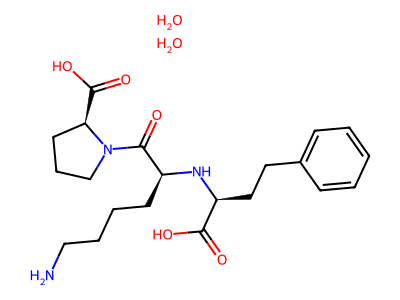
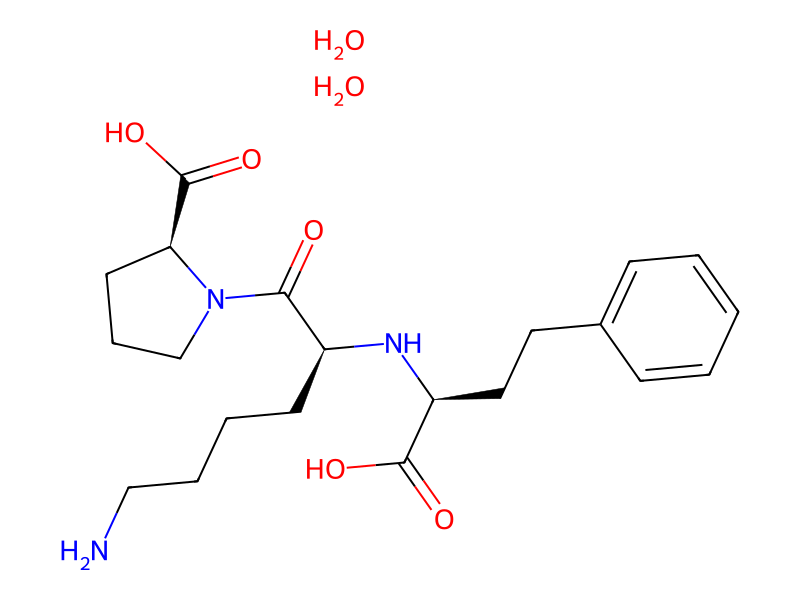
二维结构
Cite this structure
Embed this structure
SMILES
NCCCC[C@H](N[C@@H](CCc1ccccc1)C(=O)O)C(=O)N1CCC[C@H]1C(=O)O.O.O
InChI
InChI=1S/C21H31N3O5.2H2O/c22-13-5-4-9-16(19(25)24-14-6-10-18(24)21(28)29)23-17(20(26)27)12-11-15-7-2-1-3-8-15;;/h1-3,7-8,16-18,23H,4-6,9-14,22H2,(H,26,27)(H,28,29);2*1H2/t16-,17-,18-;;/m0../s1
Molecular Formula
C21H31N3O5
HBD / HBA
4 / 7
可旋转键数
12
重原子数
29
Dual RAAS blockade with ACE inhibitors and ARBs provides no additional cardiovascular benefit over either agent alone and significantly increases the risk of hypotension, hyperkalemia, and acute kidney injury.
ACE inhibitors like lisinopril reduce renal lithium excretion, causing potentially dangerous lithium toxicity.
ACE inhibitors may increase insulin sensitivity and reduce blood glucose, occasionally causing hypoglycemia in diabetic patients also using antidiabetic agents including metformin.
Adding spironolactone to an ACE inhibitor substantially increases the risk of hyperkalemia, which can cause life-threatening cardiac arrhythmias.
The combination of amlodipine and lisinopril provides complementary antihypertensive mechanisms and may cause additive hypotension, particularly with initial dosing.
Combined use of carvedilol and lisinopril in heart failure is guideline-recommended but carries additive hypotensive risk, particularly with initiation or dose uptitration.
The ACE inhibitor and thiazide combination is guideline-recommended for hypertension but can cause first-dose hypotension and metabolic disturbances including hypokalemia or hyperkalemia.
NSAIDs reduce the antihypertensive and renoprotective efficacy of ACE inhibitors and can precipitate acute kidney injury, particularly in volume-depleted or elderly patients.
Celecoxib, a selective COX-2 inhibitor, attenuates the antihypertensive effect of lisinopril and increases the risk of renal impairment.
ACE inhibitors combined with loop diuretics can cause first-dose hypotension and acute kidney injury, particularly in volume-depleted patients.
No side effects recorded
Side effect data is not yet available for this drug.
常见问题
An ACE inhibitor used to treat high blood pressure, heart failure, and kidney disease, and studied in bladder cancer and atrial fibrillation. It reduces blood pressure by preventing the production of angiotensin II, a hormone that narrows blood vessels.
ACE inhibitor preventing conversion of angiotensin I to angiotensin II.
Key pharmacokinetic parameters for Lisinopril: Half-life: 12 hours.
Yes, Lisinopril is an approved drug. It has reached clinical phase 4. It is classified as a Small molecule.
Related Drugs
Same Drug Class
Same Target
References & Data Sources
- ChEMBL — European Bioinformatics Institute (EBI). CHEMBL419213. Open-access bioactivity database.
- PubChem — National Center for Biotechnology Information (NCBI). CID 5362119. Chemical information database.
Data aggregated from publicly available pharmacological databases. Last updated 2026-03-04.
Embed This Widget
Add the script tag and a data attribute to embed this widget.
<script src="https://cdn.jsdelivr.net/npm/drugfyi-embed@1/dist/embed.min.js" defer></script>
<div data-drugfyi="drug" data-slug="lisinopril"></div>Embed via iframe for maximum compatibility.
<iframe src="https://drugfyi.com/iframe/drug/lisinopril/" width="420" height="400" frameborder="0" style="border:0;border-radius:10px;max-width:100%" loading="lazy"></iframe>Paste this URL in WordPress, Medium, or any oEmbed-compatible platform.
https://drugfyi.com/drug/lisinopril/Add a dynamic SVG badge to your README or docs.
[](https://drugfyi.com/drug/lisinopril/)Use the native HTML custom element.
<script src="https://cdn.jsdelivr.net/npm/drugfyi-embed@1/dist/embed.min.js" defer></script>
<drugfyi-drug slug="lisinopril"></drugfyi-drug>