Trimethoprim
By inhibiting bacterial dihydrofolate reductase, trimethoprim blocks the folate synthesis that microbes need to make DNA, an effect selective for bacterial over human enzymes. It treats and prevents urinary tract infections and is frequently paired with sulfamethoxazole as co-trimoxazole (Bactrim) to cover a broader range of pathogens, including certain pneumonias. The molecule has the formula C14H18N4O3. Dosing is adjusted in kidney impairment, and prolonged use can lower folate levels.
This antibiotic is used to treat and prevent urinary tract infections and is often combined with sulfamethoxazole (as co-trimoxazole or Bactrim) to treat a broader range of infections including certain types of pneumonia. It works by blocking bacterial production of folic acid, which bacteria need to make DNA. It should be used cautiously in patients with kidney problems, and folate levels may need to be monitored with long-term use.
分子量
290.3180 g/mol
LogP
0.90
TPSA
106.00 Ų
Lipinski 五规则
符合
治疗领域
药物分类
Pharmacokinetics (PK)
Pharmacodynamics (PD)
二维结构
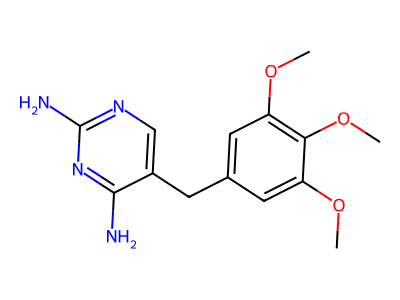
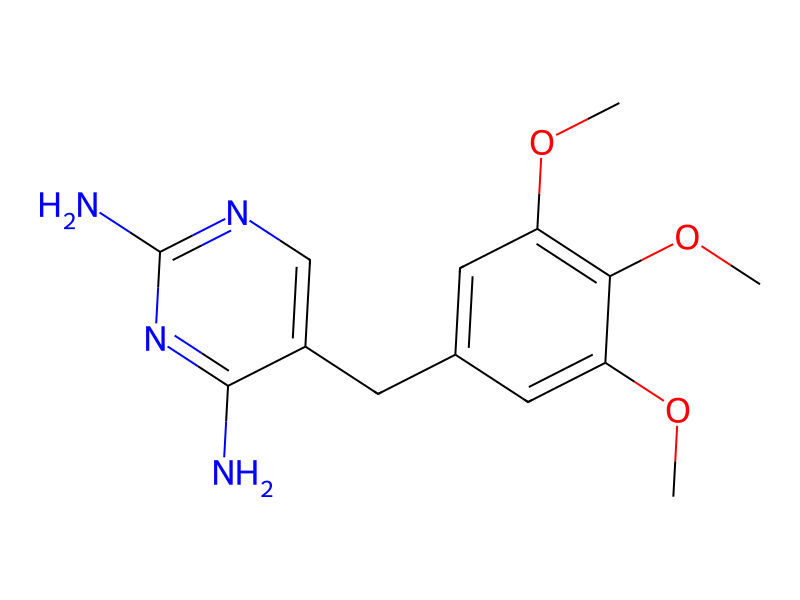
Cite this structure
Embed this structure
SMILES
COc1cc(Cc2cnc(N)nc2N)cc(OC)c1OC
InChI
InChI=1S/C14H18N4O3/c1-19-10-5-8(6-11(20-2)12(10)21-3)4-9-7-17-14(16)18-13(9)15/h5-7H,4H2,1-3H3,(H4,15,16,17,18)
Molecular Formula
C14H18N4O3
HBD / HBA
2 / 7
可旋转键数
5
重原子数
21
No targets recorded
Target interaction data is not yet available for this drug.
Trimethoprim (alone or in combination as TMP-SMX) increases warfarin's anticoagulant effect through CYP2C9 inhibition, raising INR and bleeding risk.
Trimethoprim and methotrexate both inhibit dihydrofolate reductase (DHFR), producing additive antifolate toxicity with potentially life-threatening pancytopenia and mucositis.
Trimethoprim impairs renal potassium excretion and may inhibit tubular secretion of tacrolimus, collectively increasing the risk of hyperkalemia and tacrolimus nephrotoxicity.
Trimethoprim inhibits OCT2-mediated renal secretion of metformin, increasing metformin plasma concentrations and potentially raising the risk of lactic acidosis in susceptible patients.
Trimethoprim blocks renal tubular secretion of potassium, acting like a potassium-sparing diuretic; combined with losartan's reduction of aldosterone-mediated potassium excretion, the risk of hyperkalaemia is substantially increased.
No side effects recorded
Side effect data is not yet available for this drug.
常见问题
This antibiotic is used to treat and prevent urinary tract infections and is often combined with sulfamethoxazole (as co-trimoxazole or Bactrim) to treat a broader range of infections including certain types of pneumonia. It works by blocking bacterial production of folic acid, which bacteria need to make DNA. It should be used cautiously in patients with kidney problems, and folate levels may need to be monitored with long-term use.
Key pharmacokinetic parameters for Trimethoprim: Half-life: 8-10 hours.
Yes, Trimethoprim is an approved drug. It has reached clinical phase 4. It is classified as a Small molecule.
Related Drugs
References & Data Sources
- ChEMBL — European Bioinformatics Institute (EBI). CHEMBL22. Open-access bioactivity database.
- PubChem — National Center for Biotechnology Information (NCBI). CID 5578. Chemical information database.
Data aggregated from publicly available pharmacological databases. Last updated 2026-08-20.
Embed This Widget
Add the script tag and a data attribute to embed this widget.
<script src="https://cdn.jsdelivr.net/npm/drugfyi-embed@1/dist/embed.min.js" defer></script>
<div data-drugfyi="drug" data-slug="trimethoprim"></div>Embed via iframe for maximum compatibility.
<iframe src="https://drugfyi.com/iframe/drug/trimethoprim/" width="420" height="400" frameborder="0" style="border:0;border-radius:10px;max-width:100%" loading="lazy"></iframe>Paste this URL in WordPress, Medium, or any oEmbed-compatible platform.
https://drugfyi.com/drug/trimethoprim/Add a dynamic SVG badge to your README or docs.
<a href="https://drugfyi.com/drug/trimethoprim/" rel="nofollow noopener"><img src="https://drugfyi.com/badge/entity/trimethoprim.svg" alt="DrugFYI"></a>Use the native HTML custom element.
<script src="https://cdn.jsdelivr.net/npm/drugfyi-embed@1/dist/embed.min.js" defer></script>
<drugfyi-drug slug="trimethoprim"></drugfyi-drug>