Acetazolamide
Carbonic anhydrase catalyses the hydration of carbon dioxide, and inhibiting it with acetazolamide reduces the secretion of fluid in the eye and the brain. That single mechanism produces a spread of indications: glaucoma, prevention of altitude sickness and certain forms of epilepsy. Renal carbonic anhydrase inhibition adds a second consequence, since bicarbonate is then excreted in the urine, which can be turned to advantage in correcting particular acid-base disturbances. Increased urine output and paraesthesia in the hands and feet follow predictably from these actions and are expected rather than unusual. The compound is C4H6N4O3S2 with a molecular weight near 222.3 g/mol.
A medication that reduces the production of fluid in the eye and brain by inhibiting an enzyme called carbonic anhydrase, making it useful for glaucoma, altitude sickness prevention, and certain types of epilepsy. It also promotes the excretion of bicarbonate in the urine, which can help correct certain acid-base disturbances in the body. Patients may notice increased urination and a tingling sensation in the hands and feet, which are common and expected effects.
Molecular Weight
222.3000 g/mol
LogP
-0.30
TPSA
152.00 Ų
Lipinski RO5
Pass
Therapeutic Areas
Mechanism of Action
A carbonic anhydrase inhibitor. Acetazolamide reversibly inhibits carbonic anhydrase, slowing the interconversion of carbon dioxide and water with bicarbonate and hydrogen ions. In the ciliary body this reduces aqueous humour formation and lowers intraocular pressure; in the proximal renal tubule it produces a bicarbonate diuresis and mild metabolic acidosis, which underlies its use in altitude sickness and certain seizure disorders.
Pharmacokinetics (PK)
Pharmacodynamics (PD)
A carbonic anhydrase inhibitor. Acetazolamide reversibly inhibits carbonic anhydrase, slowing the interconversion of carbon dioxide and water with bicarbonate and hydrogen ions. In the ciliary body this reduces aqueous humour …
2D Structure
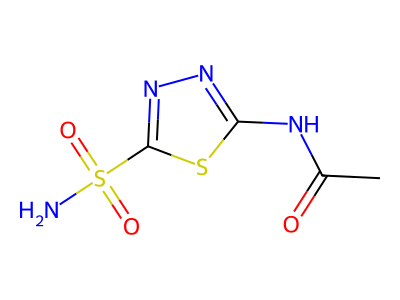
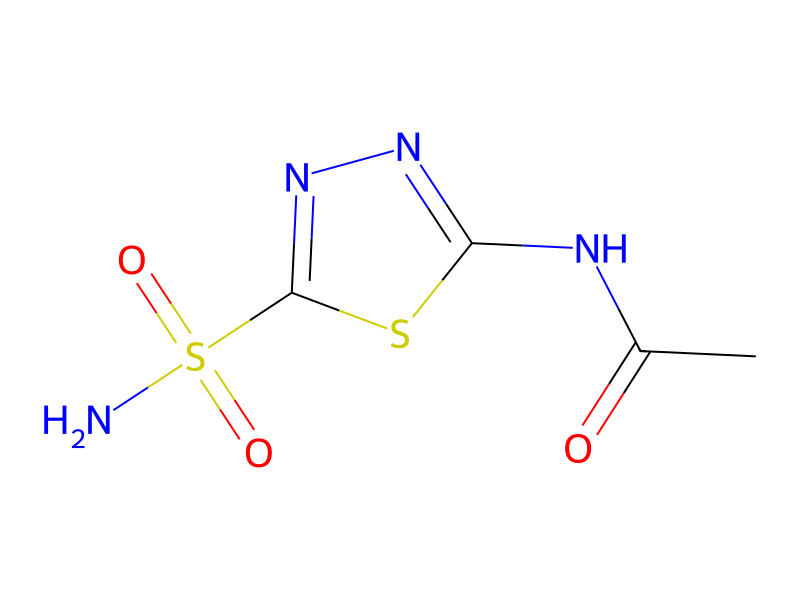
Cite this structure
Embed this structure
SMILES
CC(=O)Nc1nnc(S(N)(=O)=O)s1
InChI
InChI=1S/C4H6N4O3S2/c1-2(9)6-3-7-8-4(12-3)13(5,10)11/h1H3,(H2,5,10,11)(H,6,7,9)
Molecular Formula
C4H6N4O3S2
HBD / HBA
2 / 7
Rotatable Bonds
2
Heavy Atoms
13
No targets recorded
Target interaction data is not yet available for this drug.
No interactions recorded
Drug interaction data is not yet available for this compound.
No side effects recorded
Side effect data is not yet available for this drug.
Frequently Asked Questions
A medication that reduces the production of fluid in the eye and brain by inhibiting an enzyme called carbonic anhydrase, making it useful for glaucoma, altitude sickness prevention, and certain types of epilepsy. It also promotes the excretion of bicarbonate in the urine, which can help correct certain acid-base disturbances in the body. Patients may notice increased urination and a tingling sensation in the hands and feet, which are common and expected effects.
A carbonic anhydrase inhibitor. Acetazolamide reversibly inhibits carbonic anhydrase, slowing the interconversion of carbon dioxide and water with bicarbonate and hydrogen ions. In the ciliary body this reduces aqueous humour formation and lowers intraocular pressure; in the proximal renal tubule it produces a bicarbonate diuresis and mild metabolic acidosis, which underlies its use in altitude sickness and certain seizure disorders.
Yes, Acetazolamide is an approved drug. It has reached clinical phase 4. It is classified as a Small molecule.
References & Data Sources
- ChEMBL — European Bioinformatics Institute (EBI). CHEMBL20. Open-access bioactivity database.
- PubChem — National Center for Biotechnology Information (NCBI). CID 1986. Chemical information database.
Data aggregated from publicly available pharmacological databases. Last updated 2026-08-20.
Embed This Widget
Add the script tag and a data attribute to embed this widget.
<script src="https://cdn.jsdelivr.net/npm/drugfyi-embed@1/dist/embed.min.js" defer></script>
<div data-drugfyi="drug" data-slug="acetazolamide"></div>Embed via iframe for maximum compatibility.
<iframe src="https://drugfyi.com/iframe/drug/acetazolamide/" width="420" height="400" frameborder="0" style="border:0;border-radius:10px;max-width:100%" loading="lazy"></iframe>Paste this URL in WordPress, Medium, or any oEmbed-compatible platform.
https://drugfyi.com/drug/acetazolamide/Add a dynamic SVG badge to your README or docs.
[](https://drugfyi.com/drug/acetazolamide/)Use the native HTML custom element.
<script src="https://cdn.jsdelivr.net/npm/drugfyi-embed@1/dist/embed.min.js" defer></script>
<drugfyi-drug slug="acetazolamide"></drugfyi-drug>