Moxalactam
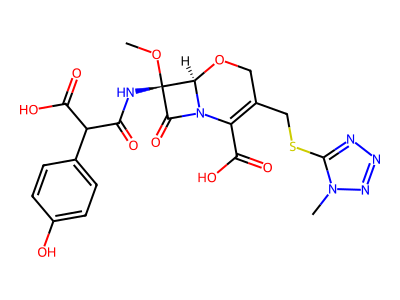
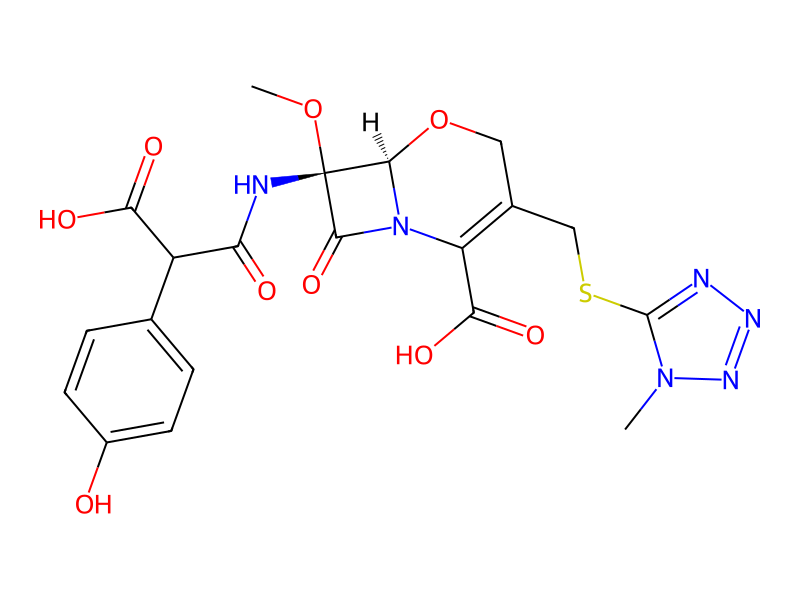
An oxacephem nucleus rather than the usual cephem ring sets moxalactam apart from the other third-generation cephalosporins, and that structural variation shaped both its spectrum and its downfall. Activity extended usefully across gram-negative organisms and anaerobes, a combination that was uncommon at the time of its introduction. The agent also interfered with vitamin K-dependent clotting factor synthesis, and the resulting serious bleeding episodes proved decisive: safer cephalosporins and other antibacterial agents have largely displaced it from practice. Its history is frequently cited when the haemostatic effects of the N-methylthiotetrazole side chain are discussed. The compound has the formula C20H20N6O9S and a molecular weight near 520.5 g/mol, and reached the final phase of clinical development.
This third-generation cephalosporin antibiotic with unusual oxacephem structure had good activity against gram-negative bacteria and anaerobes but was associated with serious bleeding problems due to interference with vitamin K-dependent clotting factors. It has been largely replaced by safer cephalosporins and other antibiotics.
Molecular Weight
520.5000 g/mol
LogP
-0.60
TPSA
232.00 Ų
Lipinski RO5
Fail
Therapeutic Areas
Mechanism of Action
An oxacephem (1-oxa-beta-lactam) antibacterial. Moxalactam binds penicillin-binding proteins and blocks the transpeptidation step that cross-links peptidoglycan, leaving a defective cell wall that fails under osmotic stress. Its N-methylthiotetrazole side chain separately interferes with vitamin K-dependent clotting factor synthesis and with platelet function, which is the origin of the bleeding that led to its withdrawal.
Pharmacokinetics (PK)
Pharmacodynamics (PD)
An oxacephem (1-oxa-beta-lactam) antibacterial. Moxalactam binds penicillin-binding proteins and blocks the transpeptidation step that cross-links peptidoglycan, leaving a defective cell wall that fails under osmotic stress. Its N-methylthiotetrazole side chain …
2D Structure
Cite this structure
Embed this structure
SMILES
CO[C@@]1(NC(=O)C(C(=O)O)c2ccc(O)cc2)C(=O)N2C(C(=O)O)=C(CSc3nnnn3C)CO[C@@H]21
InChI
InChI=1S/C20H20N6O9S/c1-25-19(22-23-24-25)36-8-10-7-35-18-20(34-2,17(33)26(18)13(10)16(31)32)21-14(28)12(15(29)30)9-3-5-11(27)6-4-9/h3-6,12,18,27H,7-8H2,1-2H3,(H,21,28)(H,29,30)(H,31,32)/t12?,18-,20+/m1/s1
Molecular Formula
C20H20N6O9S
HBD / HBA
4 / 13
Rotatable Bonds
9
Heavy Atoms
36
No targets recorded
Target interaction data is not yet available for this drug.
No interactions recorded
Drug interaction data is not yet available for this compound.
No side effects recorded
Side effect data is not yet available for this drug.
Frequently Asked Questions
This third-generation cephalosporin antibiotic with unusual oxacephem structure had good activity against gram-negative bacteria and anaerobes but was associated with serious bleeding problems due to interference with vitamin K-dependent clotting factors. It has been largely replaced by safer cephalosporins and other antibiotics.
An oxacephem (1-oxa-beta-lactam) antibacterial. Moxalactam binds penicillin-binding proteins and blocks the transpeptidation step that cross-links peptidoglycan, leaving a defective cell wall that fails under osmotic stress. Its N-methylthiotetrazole side chain separately interferes with vitamin K-dependent clotting factor synthesis and with platelet function, which is the origin of the bleeding that led to its withdrawal.
Yes, Moxalactam is an approved drug. It has reached clinical phase 4. It is classified as a Small molecule.
References & Data Sources
- ChEMBL — European Bioinformatics Institute (EBI). CHEMBL74632. Open-access bioactivity database.
- PubChem — National Center for Biotechnology Information (NCBI). CID 47499. Chemical information database.
Data aggregated from publicly available pharmacological databases. Last updated 2026-08-20.
Embed This Widget
Add the script tag and a data attribute to embed this widget.
<script src="https://cdn.jsdelivr.net/npm/drugfyi-embed@1/dist/embed.min.js" defer></script>
<div data-drugfyi="drug" data-slug="moxalactam"></div>Embed via iframe for maximum compatibility.
<iframe src="https://drugfyi.com/iframe/drug/moxalactam/" width="420" height="400" frameborder="0" style="border:0;border-radius:10px;max-width:100%" loading="lazy"></iframe>Paste this URL in WordPress, Medium, or any oEmbed-compatible platform.
https://drugfyi.com/drug/moxalactam/Add a dynamic SVG badge to your README or docs.
[](https://drugfyi.com/drug/moxalactam/)Use the native HTML custom element.
<script src="https://cdn.jsdelivr.net/npm/drugfyi-embed@1/dist/embed.min.js" defer></script>
<drugfyi-drug slug="moxalactam"></drugfyi-drug>