Prednisone
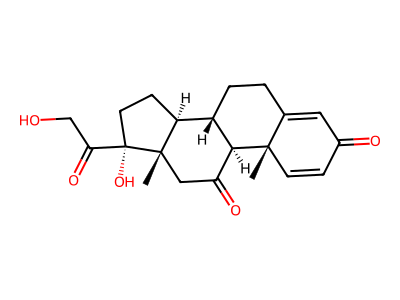
A synthetic corticosteroid, prednisone acts on the glucocorticoid receptor to suppress inflammation and dampen overactive immune responses. It is prescribed across a broad range of conditions, from asthma and allergic reactions to arthritis, autoimmune diseases, and certain cancers. Structurally it is a pregnane derivative with the molecular formula C21H26O5, marketed under names including Deltasone, Rayos, and Sterapred. Prolonged use affects bone density, blood glucose, and immune function, so extended courses are accompanied by monitoring. Its potency and versatility have made it one of the most widely used systemic steroids in clinical medicine.
A widely used corticosteroid that reduces inflammation and calms overactive immune responses, prescribed for conditions ranging from asthma and allergic reactions to arthritis, certain cancers, and autoimmune diseases. Long-term use requires careful monitoring as it can affect bone density, blood sugar, and immune function.
Molecular Weight
358.4280 g/mol
LogP
1.50
TPSA
91.70 Ų
Lipinski RO5
Pass
Therapeutic Areas
Drug Classes
Mechanism of Action
Synthetic corticosteroid; suppresses inflammation via glucocorticoid receptor.
Pharmacokinetics (PK)
Pharmacodynamics (PD)
Synthetic corticosteroid; suppresses inflammation via glucocorticoid receptor.
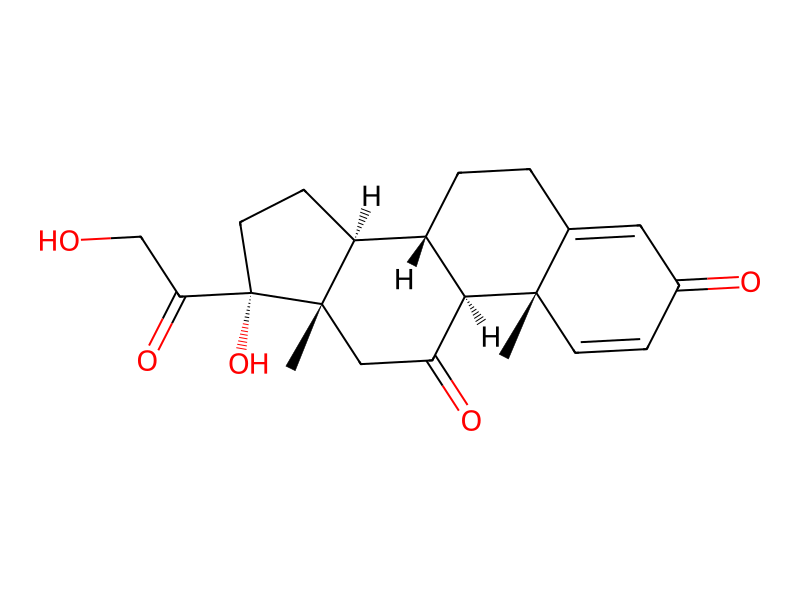
2D Structure
Cite this structure
Embed this structure
SMILES
C[C@]12C=CC(=O)C=C1CC[C@@H]1[C@@H]2C(=O)C[C@@]2(C)[C@H]1CC[C@]2(O)C(=O)CO
InChI
InChI=1S/C21H26O5/c1-19-7-5-13(23)9-12(19)3-4-14-15-6-8-21(26,17(25)11-22)20(15,2)10-16(24)18(14)19/h5,7,9,14-15,18,22,26H,3-4,6,8,10-11H2,1-2H3/t14-,15-,18+,19-,20-,21-/m0/s1
Molecular Formula
C21H26O5
HBD / HBA
2 / 5
Rotatable Bonds
2
Heavy Atoms
26
No targets recorded
Target interaction data is not yet available for this drug.
Corticosteroids have a complex and variable interaction with warfarin; high doses may increase bleeding risk via GI mucosal effects while also affecting clotting factor synthesis.
Supraphysiologic doses of corticosteroids such as prednisone can suppress TSH secretion and reduce T4-to-T3 conversion, complicating thyroid function interpretation during steroid courses.
Prednisone may increase salicylate clearance, reducing aspirin's anti-inflammatory efficacy, and combined GI toxicity is substantially increased.
Combining ibuprofen with corticosteroids dramatically increases the risk of GI ulcers and hemorrhage beyond the risk of either agent alone.
Prednisone causes dose-dependent hyperglycaemia that can overcome metformin's glucose-lowering capacity, resulting in poorly controlled blood glucose, particularly postprandially.
Prednisone at immunosuppressive doses may blunt pembrolizumab's anti-tumour efficacy by dampening the T-cell responses required for checkpoint inhibitor activity.
No side effects recorded
Side effect data is not yet available for this drug.
Frequently Asked Questions
A widely used corticosteroid that reduces inflammation and calms overactive immune responses, prescribed for conditions ranging from asthma and allergic reactions to arthritis, certain cancers, and autoimmune diseases. Long-term use requires careful monitoring as it can affect bone density, blood sugar, and immune function.
Synthetic corticosteroid; suppresses inflammation via glucocorticoid receptor.
Key pharmacokinetic parameters for Prednisone: Half-life: 2-3 hours.
Yes, Prednisone is an approved drug. It has reached clinical phase 4. It is classified as a Small molecule.
Related Drugs
References & Data Sources
- ChEMBL — European Bioinformatics Institute (EBI). CHEMBL635. Open-access bioactivity database.
- PubChem — National Center for Biotechnology Information (NCBI). CID 5865. Chemical information database.
Data aggregated from publicly available pharmacological databases. Last updated 2026-03-28.
Embed This Widget
Add the script tag and a data attribute to embed this widget.
<script src="https://cdn.jsdelivr.net/npm/drugfyi-embed@1/dist/embed.min.js" defer></script>
<div data-drugfyi="drug" data-slug="prednisone"></div>Embed via iframe for maximum compatibility.
<iframe src="https://drugfyi.com/iframe/drug/prednisone/" width="420" height="400" frameborder="0" style="border:0;border-radius:10px;max-width:100%" loading="lazy"></iframe>Paste this URL in WordPress, Medium, or any oEmbed-compatible platform.
https://drugfyi.com/drug/prednisone/Add a dynamic SVG badge to your README or docs.
[](https://drugfyi.com/drug/prednisone/)Use the native HTML custom element.
<script src="https://cdn.jsdelivr.net/npm/drugfyi-embed@1/dist/embed.min.js" defer></script>
<drugfyi-drug slug="prednisone"></drugfyi-drug>