Valproic Acid
By raising levels of the inhibitory neurotransmitter GABA and blocking sodium and calcium channels, valproic acid stabilizes abnormal electrical activity in the brain. It treats several seizure types in epilepsy, serves as a mood stabilizer in bipolar disorder, and is used to prevent migraines. A short-chain fatty acid with the formula C8H16O2, it is among the oldest broad-spectrum antiepileptics. Valproic acid is contraindicated in pregnancy because of a high risk of birth defects and developmental problems, and treatment is accompanied by monitoring of liver function and blood counts.
This medication is used to treat epilepsy (multiple seizure types), bipolar disorder (as a mood stabilizer), and to prevent migraines. It works by increasing the levels of the calming neurotransmitter GABA in the brain and by stabilizing electrical activity. It must never be taken during pregnancy due to a high risk of birth defects and developmental problems in the baby, and liver function and blood counts require regular monitoring.
Molecular Weight
144.2110 g/mol
LogP
2.80
TPSA
37.30 Ų
Lipinski RO5
Pass
Therapeutic Areas
Drug Classes
Mechanism of Action
Enhances GABA transmission and blocks sodium/calcium channels.
Pharmacokinetics (PK)
Pharmacodynamics (PD)
Enhances GABA transmission and blocks sodium/calcium channels.
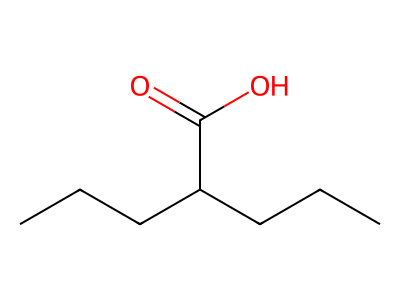
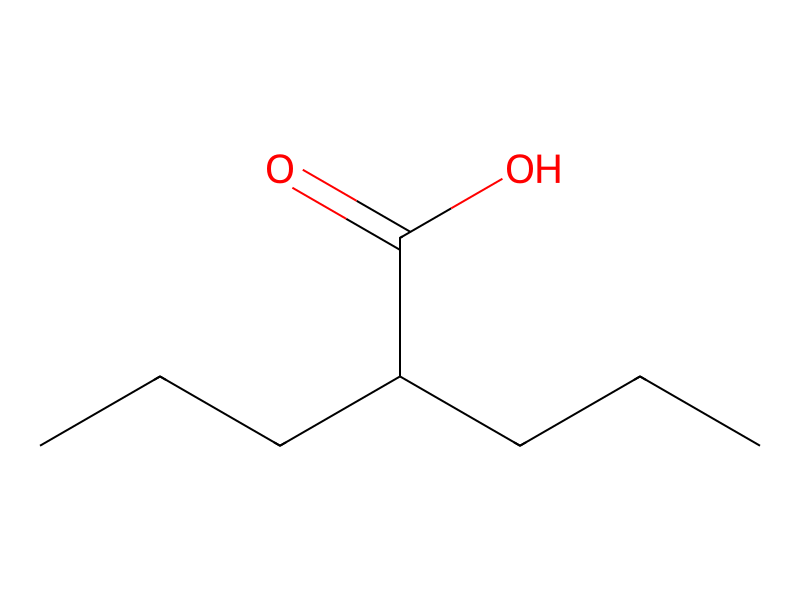
2D Structure
Cite this structure
Embed this structure
SMILES
CCCC(CCC)C(=O)O
InChI
InChI=1S/C8H16O2/c1-3-5-7(6-4-2)8(9)10/h7H,3-6H2,1-2H3,(H,9,10)
Molecular Formula
C8H16O2
HBD / HBA
1 / 2
Rotatable Bonds
5
Heavy Atoms
10
No targets recorded
Target interaction data is not yet available for this drug.
Valproic acid can displace warfarin from plasma protein binding sites and may inhibit platelet aggregation, increasing bleeding risk.
Valproic acid doubles lamotrigine plasma concentrations by inhibiting its glucuronidation; the combination is associated with Stevens-Johnson syndrome and toxic epidermal necrolysis.
The combination of topiramate and valproic acid is associated with hyperammonemia and encephalopathy even without hepatotoxicity, representing a unique metabolic interaction.
Gabapentin and valproic acid have a minor pharmacokinetic interaction; valproate may slightly increase gabapentin renal clearance.
Carbamazepine reduces valproic acid levels through enzyme induction, while valproic acid inhibits epoxide hydrolase, increasing the toxic carbamazepine-10,11-epoxide metabolite.
Valproic acid displaces phenytoin from protein binding and inhibits its metabolism, leading to increased free phenytoin levels despite total levels that may appear unchanged or decreased.
No side effects recorded
Side effect data is not yet available for this drug.
Frequently Asked Questions
This medication is used to treat epilepsy (multiple seizure types), bipolar disorder (as a mood stabilizer), and to prevent migraines. It works by increasing the levels of the calming neurotransmitter GABA in the brain and by stabilizing electrical activity. It must never be taken during pregnancy due to a high risk of birth defects and developmental problems in the baby, and liver function and blood counts require regular monitoring.
Enhances GABA transmission and blocks sodium/calcium channels.
Key pharmacokinetic parameters for Valproic Acid: Half-life: 9-16 hours.
Yes, Valproic Acid is an approved drug. It has reached clinical phase 4. It is classified as a Small molecule.
Related Drugs
References & Data Sources
- ChEMBL — European Bioinformatics Institute (EBI). CHEMBL109. Open-access bioactivity database.
- PubChem — National Center for Biotechnology Information (NCBI). CID 3121. Chemical information database.
Data aggregated from publicly available pharmacological databases. Last updated 2026-03-28.
Embed This Widget
Add the script tag and a data attribute to embed this widget.
<script src="https://cdn.jsdelivr.net/npm/drugfyi-embed@1/dist/embed.min.js" defer></script>
<div data-drugfyi="drug" data-slug="valproic-acid"></div>Embed via iframe for maximum compatibility.
<iframe src="https://drugfyi.com/iframe/drug/valproic-acid/" width="420" height="400" frameborder="0" style="border:0;border-radius:10px;max-width:100%" loading="lazy"></iframe>Paste this URL in WordPress, Medium, or any oEmbed-compatible platform.
https://drugfyi.com/drug/valproic-acid/Add a dynamic SVG badge to your README or docs.
[](https://drugfyi.com/drug/valproic-acid/)Use the native HTML custom element.
<script src="https://cdn.jsdelivr.net/npm/drugfyi-embed@1/dist/embed.min.js" defer></script>
<drugfyi-drug slug="valproic-acid"></drugfyi-drug>