Amenamevir
Herpesvirus replication requires a helicase-primase complex to unwind and prime viral DNA, and amenamevir was designed to inhibit that complex. This places it outside the nucleoside-analogue class represented by acyclovir, which instead depends on viral thymidine kinase activation and chain termination. The mechanistic separation matters clinically, since it offers a route to activity against herpesvirus strains that have become resistant to nucleoside analogues. Approval in Japan covers herpes zoster, the reactivation syndrome caused by varicella-zoster virus. Structurally the agent is a small molecule with the formula C24H26N4O5S and a molecular weight of roughly 482.6 g/mol, and it has reached the final phase of clinical development.
An antiviral medication that inhibits the helicase-primase enzyme complex essential for herpesvirus DNA replication, offering a different mechanism of action from nucleoside analogues like acyclovir. It is approved in Japan for treating herpes zoster (shingles) and may be effective in patients with acyclovir-resistant herpesvirus infections.
Peso molecular
482,6000 g/mol
LogP
2,60
TPSA
131,00 Ų
Regla de cinco de Lipinski
Cumple
Áreas terapéuticas
Mecanismo de acción
A helicase-primase inhibitor. Amenamevir binds the herpesvirus helicase-primase complex, blocking both the unwinding of double-stranded viral DNA and the synthesis of the RNA primers needed to start replication. Because the mechanism does not depend on viral thymidine kinase activation, it remains active against strains resistant to nucleoside analogues such as acyclovir.
Pharmacokinetics (PK)
Pharmacodynamics (PD)
A helicase-primase inhibitor. Amenamevir binds the herpesvirus helicase-primase complex, blocking both the unwinding of double-stranded viral DNA and the synthesis of the RNA primers needed to start replication. Because the …
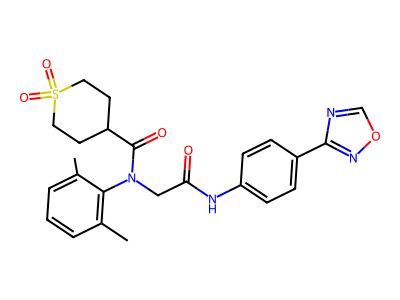
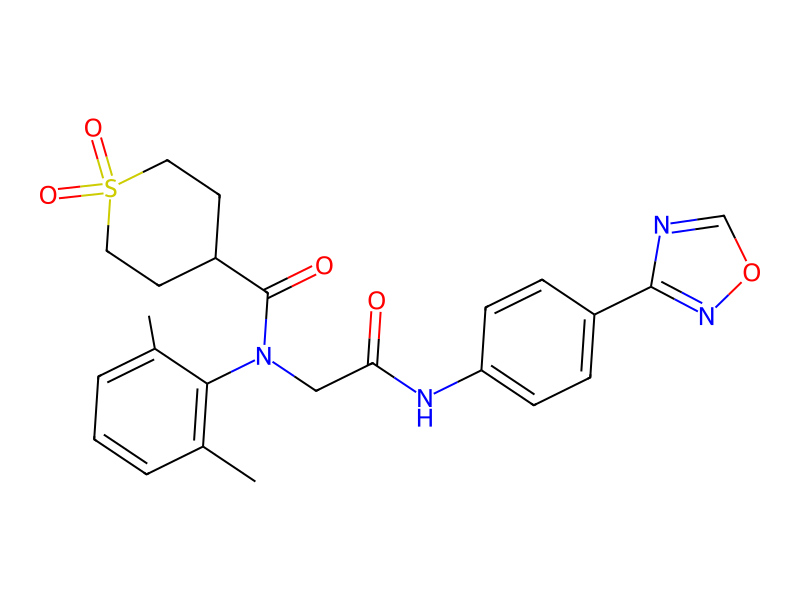
Estructura 2D
Cite this structure
Embed this structure
SMILES
Cc1cccc(C)c1N(CC(=O)Nc1ccc(-c2ncon2)cc1)C(=O)C1CCS(=O)(=O)CC1
InChI
InChI=1S/C24H26N4O5S/c1-16-4-3-5-17(2)22(16)28(24(30)19-10-12-34(31,32)13-11-19)14-21(29)26-20-8-6-18(7-9-20)23-25-15-33-27-23/h3-9,15,19H,10-14H2,1-2H3,(H,26,29)
Molecular Formula
C24H26N4O5S
HBD / HBA
1 / 7
Enlaces Rotables
6
Átomos Pesados
34
No targets recorded
Target interaction data is not yet available for this drug.
No interactions recorded
Drug interaction data is not yet available for this compound.
No side effects recorded
Side effect data is not yet available for this drug.
Preguntas frecuentes
An antiviral medication that inhibits the helicase-primase enzyme complex essential for herpesvirus DNA replication, offering a different mechanism of action from nucleoside analogues like acyclovir. It is approved in Japan for treating herpes zoster (shingles) and may be effective in patients with acyclovir-resistant herpesvirus infections.
A helicase-primase inhibitor. Amenamevir binds the herpesvirus helicase-primase complex, blocking both the unwinding of double-stranded viral DNA and the synthesis of the RNA primers needed to start replication. Because the mechanism does not depend on viral thymidine kinase activation, it remains active against strains resistant to nucleoside analogues such as acyclovir.
Yes, Amenamevir is an approved drug. It has reached clinical phase 4. It is classified as a Small molecule.
References & Data Sources
- ChEMBL — European Bioinformatics Institute (EBI). CHEMBL4297592. Open-access bioactivity database.
- PubChem — National Center for Biotechnology Information (NCBI). CID 11397521. Chemical information database.
Data aggregated from publicly available pharmacological databases. Last updated 2026-08-20.
Embed This Widget
Add the script tag and a data attribute to embed this widget.
<script src="https://cdn.jsdelivr.net/npm/drugfyi-embed@1/dist/embed.min.js" defer></script>
<div data-drugfyi="drug" data-slug="amenamevir"></div>Embed via iframe for maximum compatibility.
<iframe src="https://drugfyi.com/iframe/drug/amenamevir/" width="420" height="400" frameborder="0" style="border:0;border-radius:10px;max-width:100%" loading="lazy"></iframe>Paste this URL in WordPress, Medium, or any oEmbed-compatible platform.
https://drugfyi.com/drug/amenamevir/Add a dynamic SVG badge to your README or docs.
[](https://drugfyi.com/drug/amenamevir/)Use the native HTML custom element.
<script src="https://cdn.jsdelivr.net/npm/drugfyi-embed@1/dist/embed.min.js" defer></script>
<drugfyi-drug slug="amenamevir"></drugfyi-drug>