Fluoxetine
By blocking the reabsorption of serotonin into nerve terminals, fluoxetine increases the neurotransmitter's presence in synapses, an action that gradually improves mood and reduces obsessive and anxious symptoms. It belongs to the selective serotonin reuptake inhibitor class and became one of the most widely prescribed antidepressants, with additional use in bulimia nervosa and panic disorder. A trifluoromethyl small molecule (C17H18F3NO), it is distinguished by an unusually long duration of action: the parent drug persists for one to three days, and an active metabolite extends its reach further, so effects fade slowly after the medicine is stopped. That prolonged clearance sets it apart from shorter-acting agents in the same family. Fluoxetine is an approved medication used across several psychiatric conditions.
This selective serotonin reuptake inhibitor increases serotonin levels in the brain to improve mood, reduce anxiety, and treat obsessive-compulsive behaviors. It is one of the most widely prescribed antidepressants and is also used for bulimia nervosa and panic disorder.
Peso molecular
309,3260 g/mol
LogP
4,00
TPSA
21,30 Ų
Regla de cinco de Lipinski
Cumple
Áreas terapéuticas
Clases de fármacos
Mecanismo de acción
Selective serotonin reuptake inhibitor (SSRI).
Pharmacokinetics (PK)
Pharmacodynamics (PD)
Selective serotonin reuptake inhibitor (SSRI).
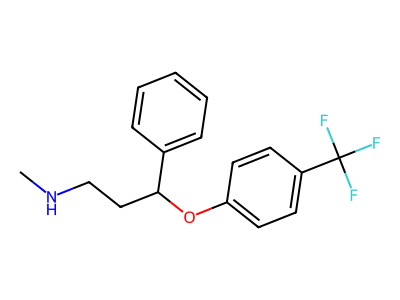
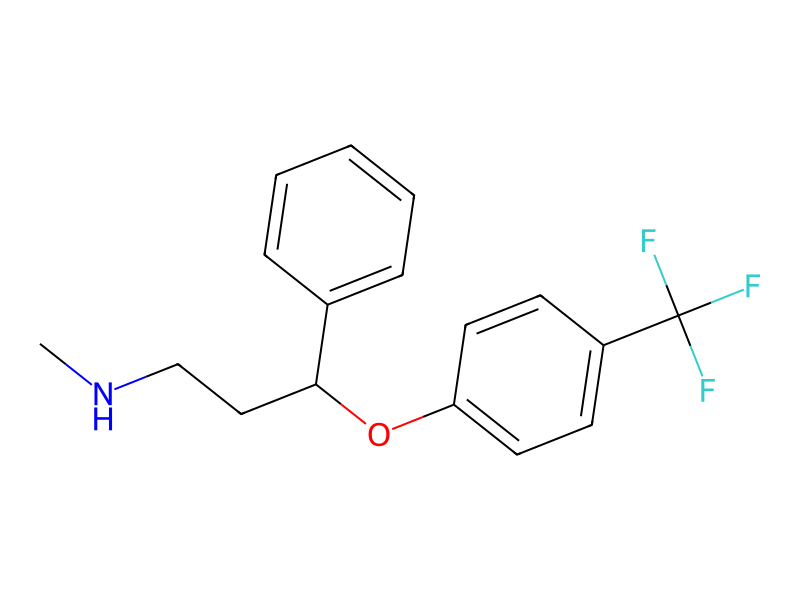
Estructura 2D
Cite this structure
Embed this structure
SMILES
CNCCC(Oc1ccc(C(F)(F)F)cc1)c1ccccc1
InChI
InChI=1S/C17H18F3NO/c1-21-12-11-16(13-5-3-2-4-6-13)22-15-9-7-14(8-10-15)17(18,19)20/h2-10,16,21H,11-12H2,1H3
Molecular Formula
C17H18F3NO
HBD / HBA
1 / 5
Enlaces Rotables
6
Átomos Pesados
22
Fluoxetine combined with tramadol carries a high risk of serotonin syndrome and additionally reduces tramadol's analgesic efficacy via CYP2D6 inhibition.
Concurrent fluoxetine and lithium may increase serotonin syndrome risk; fluoxetine may also alter lithium pharmacokinetics in some patients.
Fluoxetine plus sumatriptan may potentiate serotonin syndrome risk, though the clinical evidence is mixed and the absolute risk is debated.
Fluoxetine increases warfarin plasma levels via CYP2C9 inhibition and may independently impair platelet function, raising hemorrhagic risk.
Fluoxetine inhibits CYP2D6 and CYP3A4, increasing quetiapine plasma concentrations and potentially enhancing both therapeutic and adverse effects.
Fluoxetine can enhance insulin sensitivity and potentiate hypoglycaemia in patients on insulin therapy, particularly during the first weeks of treatment.
Fluoxetine inhibits CYP2D6-mediated metabolism of trazodone, significantly increasing trazodone plasma levels and serotonin syndrome risk.
Combining two SSRIs is generally contraindicated due to markedly elevated serotonin syndrome risk and no additional therapeutic benefit.
Fluoxetine is a potent CYP2D6 inhibitor that substantially increases duloxetine plasma levels, while both agents also increase serotonin syndrome risk.
Aspirin combined with fluoxetine increases GI hemorrhage risk through synergistic platelet impairment and CYP2C9-mediated interactions.
Fluoxetine may reduce clopidogrel's antiplatelet efficacy by inhibiting CYP2C19-mediated bioactivation while also independently impairing platelet serotonin-mediated aggregation.
Fluoxetine is a potent CYP2D6 inhibitor that significantly increases aripiprazole plasma concentrations, enhancing both efficacy and adverse effects.
No side effects recorded
Side effect data is not yet available for this drug.
Preguntas frecuentes
This selective serotonin reuptake inhibitor increases serotonin levels in the brain to improve mood, reduce anxiety, and treat obsessive-compulsive behaviors. It is one of the most widely prescribed antidepressants and is also used for bulimia nervosa and panic disorder.
Selective serotonin reuptake inhibitor (SSRI).
Key pharmacokinetic parameters for Fluoxetine: Half-life: 1-3 days.
Yes, Fluoxetine is an approved drug. It has reached clinical phase 4. It is classified as a Small molecule.
Related Drugs
Same Drug Class
References & Data Sources
- ChEMBL — European Bioinformatics Institute (EBI). CHEMBL41. Open-access bioactivity database.
- PubChem — National Center for Biotechnology Information (NCBI). CID 3386. Chemical information database.
Data aggregated from publicly available pharmacological databases. Last updated 2026-03-04.
Embed This Widget
Add the script tag and a data attribute to embed this widget.
<script src="https://cdn.jsdelivr.net/npm/drugfyi-embed@1/dist/embed.min.js" defer></script>
<div data-drugfyi="drug" data-slug="fluoxetine"></div>Embed via iframe for maximum compatibility.
<iframe src="https://drugfyi.com/iframe/drug/fluoxetine/" width="420" height="400" frameborder="0" style="border:0;border-radius:10px;max-width:100%" loading="lazy"></iframe>Paste this URL in WordPress, Medium, or any oEmbed-compatible platform.
https://drugfyi.com/drug/fluoxetine/Add a dynamic SVG badge to your README or docs.
[](https://drugfyi.com/drug/fluoxetine/)Use the native HTML custom element.
<script src="https://cdn.jsdelivr.net/npm/drugfyi-embed@1/dist/embed.min.js" defer></script>
<drugfyi-drug slug="fluoxetine"></drugfyi-drug>