Loratadine
A second-generation, non-sedating antihistamine, loratadine blocks peripheral H1 histamine receptors to reduce sneezing, runny nose, and itching without causing significant drowsiness. It treats allergic rhinitis and chronic hives. Sold over the counter as Claritin and Alavert, the compound has the formula C22H23ClN2O2 and its minimal central nervous system penetration distinguishes it from older allergy medications.
A second-generation, non-sedating antihistamine used to relieve allergic rhinitis and hives (urticaria). It blocks peripheral H1 histamine receptors to reduce sneezing, runny nose, and itching without causing significant drowsiness.
Peso molecular
382,8800 g/mol
LogP
5,20
TPSA
42,40 Ų
Regla de cinco de Lipinski
Cumple
Clases de fármacos
Mecanismo de acción
Second-generation H1 antihistamine with minimal CNS effects.
Pharmacokinetics (PK)
Pharmacodynamics (PD)
Second-generation H1 antihistamine with minimal CNS effects.
Estructura 2D
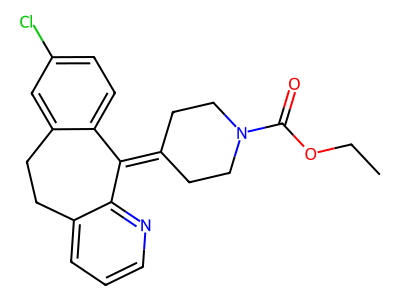
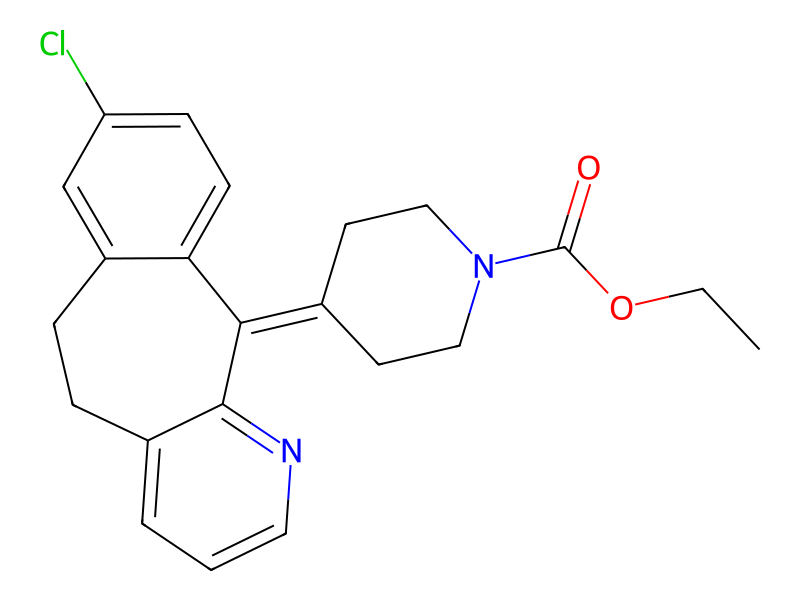
Cite this structure
Embed this structure
SMILES
CCOC(=O)N1CCC(=C2c3ccc(Cl)cc3CCc3cccnc32)CC1
InChI
InChI=1S/C22H23ClN2O2/c1-2-27-22(26)25-12-9-15(10-13-25)20-19-8-7-18(23)14-17(19)6-5-16-4-3-11-24-21(16)20/h3-4,7-8,11,14H,2,5-6,9-10,12-13H2,1H3
Molecular Formula
C22H23ClN2O2
HBD / HBA
- / 3
Enlaces Rotables
2
Átomos Pesados
27
Fluconazole inhibits CYP3A4-mediated metabolism of loratadine, modestly increasing loratadine plasma concentrations; however, loratadine's poor CNS penetration limits the clinical consequence.
Azithromycin is a weak CYP3A4 inhibitor that can modestly raise loratadine plasma levels; the clinical impact is minimal given loratadine's wide therapeutic index and low cardiac risk.
No side effects recorded
Side effect data is not yet available for this drug.
Preguntas frecuentes
A second-generation, non-sedating antihistamine used to relieve allergic rhinitis and hives (urticaria). It blocks peripheral H1 histamine receptors to reduce sneezing, runny nose, and itching without causing significant drowsiness.
Second-generation H1 antihistamine with minimal CNS effects.
Key pharmacokinetic parameters for Loratadine: Half-life: 8 hours.
Yes, Loratadine is an approved drug. It has reached clinical phase 4. It is classified as a Small molecule.
Related Drugs
Same Drug Class
References & Data Sources
- ChEMBL — European Bioinformatics Institute (EBI). CHEMBL998. Open-access bioactivity database.
- PubChem — National Center for Biotechnology Information (NCBI). CID 3957. Chemical information database.
Data aggregated from publicly available pharmacological databases. Last updated 2026-03-04.
Embed This Widget
Add the script tag and a data attribute to embed this widget.
<script src="https://cdn.jsdelivr.net/npm/drugfyi-embed@1/dist/embed.min.js" defer></script>
<div data-drugfyi="drug" data-slug="loratadine"></div>Embed via iframe for maximum compatibility.
<iframe src="https://drugfyi.com/iframe/drug/loratadine/" width="420" height="400" frameborder="0" style="border:0;border-radius:10px;max-width:100%" loading="lazy"></iframe>Paste this URL in WordPress, Medium, or any oEmbed-compatible platform.
https://drugfyi.com/drug/loratadine/Add a dynamic SVG badge to your README or docs.
[](https://drugfyi.com/drug/loratadine/)Use the native HTML custom element.
<script src="https://cdn.jsdelivr.net/npm/drugfyi-embed@1/dist/embed.min.js" defer></script>
<drugfyi-drug slug="loratadine"></drugfyi-drug>