Acyclovir
By mimicking a nucleoside building block and inhibiting viral DNA polymerase, acyclovir stops the herpes simplex and varicella-zoster viruses from copying their DNA. It treats cold sores, genital herpes, chickenpox, and shingles, and shortens outbreaks most effectively when started early. Marketed as Zovirax, the guanosine analogue has the formula C8H11N5O3. Taken daily at lower doses, it can suppress recurrent outbreaks in people with frequent episodes.
An antiviral medication that stops the herpes simplex and varicella-zoster viruses from replicating by mimicking one of the building blocks the virus needs to copy its DNA. It is used to treat cold sores, genital herpes, chickenpox, and shingles, and can reduce the severity and duration of outbreaks when started early. Long-term daily use at a lower dose can suppress recurrent outbreaks in people with frequent episodes.
Masse moléculaire
225,2050 g/mol
LogP
-1,90
TPSA
115,00 Ų
Règle des 5 de Lipinski
Conforme
Aires thérapeutiques
Classes de médicaments
Mécanisme d'action
Guanosine analogue inhibiting viral DNA polymerase.
Pharmacokinetics (PK)
Pharmacodynamics (PD)
Guanosine analogue inhibiting viral DNA polymerase.
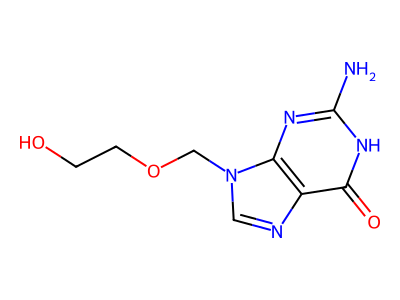
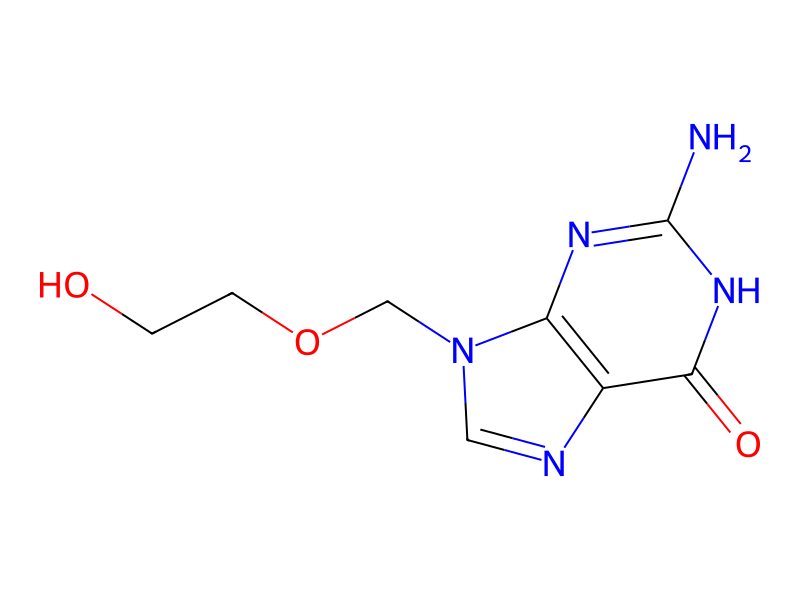
Structure 2D
Cite this structure
Embed this structure
SMILES
Nc1nc2c(ncn2COCCO)c(=O)[nH]1
InChI
InChI=1S/C8H11N5O3/c9-8-11-6-5(7(15)12-8)10-3-13(6)4-16-2-1-14/h3,14H,1-2,4H2,(H3,9,11,12,15)
Molecular Formula
C8H11N5O3
HBD / HBA
3 / 5
Liaisons Rotatives
4
Atomes Lourds
16
No targets recorded
Target interaction data is not yet available for this drug.
Acyclovir has been associated with reduced phenytoin plasma concentrations in some patients, potentially compromising seizure control during antiviral therapy.
Concurrent use of acyclovir and cyclosporine can increase nephrotoxicity risk, as both agents are renally cleared and individually nephrotoxic.
No side effects recorded
Side effect data is not yet available for this drug.
Foire aux questions
An antiviral medication that stops the herpes simplex and varicella-zoster viruses from replicating by mimicking one of the building blocks the virus needs to copy its DNA. It is used to treat cold sores, genital herpes, chickenpox, and shingles, and can reduce the severity and duration of outbreaks when started early. Long-term daily use at a lower dose can suppress recurrent outbreaks in people with frequent episodes.
Guanosine analogue inhibiting viral DNA polymerase.
Key pharmacokinetic parameters for Acyclovir: Half-life: 2.5-3.3 hours.
Yes, Acyclovir is an approved drug. It has reached clinical phase 4. It is classified as a Small molecule.
Related Drugs
References & Data Sources
- ChEMBL — European Bioinformatics Institute (EBI). CHEMBL184. Open-access bioactivity database.
- PubChem — National Center for Biotechnology Information (NCBI). CID 135398513. Chemical information database.
Data aggregated from publicly available pharmacological databases. Last updated 2026-03-04.
Embed This Widget
Add the script tag and a data attribute to embed this widget.
<script src="https://cdn.jsdelivr.net/npm/drugfyi-embed@1/dist/embed.min.js" defer></script>
<div data-drugfyi="drug" data-slug="acyclovir"></div>Embed via iframe for maximum compatibility.
<iframe src="https://drugfyi.com/iframe/drug/acyclovir/" width="420" height="400" frameborder="0" style="border:0;border-radius:10px;max-width:100%" loading="lazy"></iframe>Paste this URL in WordPress, Medium, or any oEmbed-compatible platform.
https://drugfyi.com/drug/acyclovir/Add a dynamic SVG badge to your README or docs.
[](https://drugfyi.com/drug/acyclovir/)Use the native HTML custom element.
<script src="https://cdn.jsdelivr.net/npm/drugfyi-embed@1/dist/embed.min.js" defer></script>
<drugfyi-drug slug="acyclovir"></drugfyi-drug>