Sodium Thiosulfate
Sodium thiosulfate is used as an antidote for cyanide poisoning (in combination with sodium nitrite or hydroxocobalamin) by acting as a sulfur donor that allows rhodanese enzyme to convert cyanide to the less toxic thiocyanate for renal excretion. It is also used to treat cisplatin-induced nephrotoxicity and ototoxicity by chelating platinum compounds, and topically for tinea versicolor and calciphylaxis. Its reactive sulfhydryl groups provide reductive detoxification of multiple cytotoxic agents.
Masse moléculaire
158,1100 g/mol
TPSA
104,00 Ų
Pharmacokinetics (PK)
Pharmacodynamics (PD)
Structure 2D
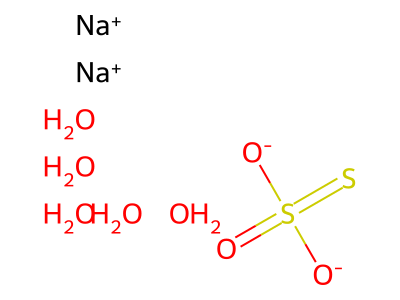
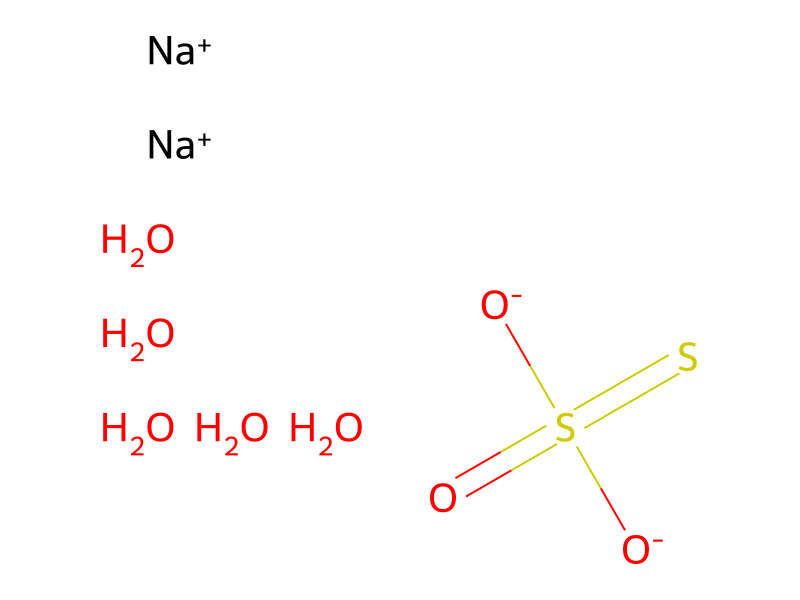
Cite this structure
Embed this structure
SMILES
O.O.O.O.O.O=S([O-])([O-])=S.[Na+].[Na+]
InChI
InChI=1S/2Na.H2O3S2.5H2O/c;;1-5(2,3)4;;;;;/h;;(H2,1,2,3,4);5*1H2/q2*+1;;;;;;/p-2
Molecular Formula
Na2O3S2
HBD / HBA
- / 4
Liaisons Rotatives
0
Atomes Lourds
7
No targets recorded
Target interaction data is not yet available for this drug.
No interactions recorded
Drug interaction data is not yet available for this compound.
No side effects recorded
Side effect data is not yet available for this drug.
Foire aux questions
Sodium thiosulfate is used as an antidote for cyanide poisoning (in combination with sodium nitrite or hydroxocobalamin) by acting as a sulfur donor that allows rhodanese enzyme to convert cyanide to the less toxic thiocyanate for renal excretion. It is also used to treat cisplatin-induced nephrotoxicity and ototoxicity by chelating platinum compounds, and topically for tinea versicolor and calciphylaxis. Its reactive sulfhydryl groups provide reductive detoxification of multiple cytotoxic agents.
Yes, Sodium Thiosulfate is an approved drug. It has reached clinical phase 4. It is classified as a Small molecule.
References & Data Sources
- ChEMBL — European Bioinformatics Institute (EBI). CHEMBL2096650. Open-access bioactivity database.
- PubChem — National Center for Biotechnology Information (NCBI). CID 24477. Chemical information database.
Data aggregated from publicly available pharmacological databases. Last updated 2026-08-20.
Embed This Widget
Add the script tag and a data attribute to embed this widget.
<script src="https://cdn.jsdelivr.net/npm/drugfyi-embed@1/dist/embed.min.js" defer></script>
<div data-drugfyi="drug" data-slug="sodium-thiosulfate"></div>Embed via iframe for maximum compatibility.
<iframe src="https://drugfyi.com/iframe/drug/sodium-thiosulfate/" width="420" height="400" frameborder="0" style="border:0;border-radius:10px;max-width:100%" loading="lazy"></iframe>Paste this URL in WordPress, Medium, or any oEmbed-compatible platform.
https://drugfyi.com/drug/sodium-thiosulfate/Add a dynamic SVG badge to your README or docs.
[](https://drugfyi.com/drug/sodium-thiosulfate/)Use the native HTML custom element.
<script src="https://cdn.jsdelivr.net/npm/drugfyi-embed@1/dist/embed.min.js" defer></script>
<drugfyi-drug slug="sodium-thiosulfate"></drugfyi-drug>