Metronidazole
Reductive activation inside anaerobic organisms converts metronidazole into cytotoxic free radicals that fragment microbial DNA, an activation step that requires the low-redox environment such organisms provide and that explains the drug's selectivity. Its spectrum spans both bacteria and protozoa, supporting use in infections of the digestive tract, the reproductive system and the skin. Warfarin is recorded as a major interaction, the anticoagulant effect being potentiated when the two are given together. An elimination half-life near eight hours accompanies its classification among antiinfectives for systemic use. The molecule is small, C6H9N3O3 at approximately 171.2 g/mol, and reached the final phase of clinical development.
This antibiotic and antiprotozoal drug kills bacteria and parasites by damaging their DNA. It is used to treat a wide range of infections including those of the digestive tract, reproductive system, and skin.
분자량
171.1540 g/mol
LogP
0.00
TPSA
83.90 Ų
리핀스키 5의 법칙
통과
치료 영역
약물 분류
Pharmacokinetics (PK)
Pharmacodynamics (PD)
2D 구조
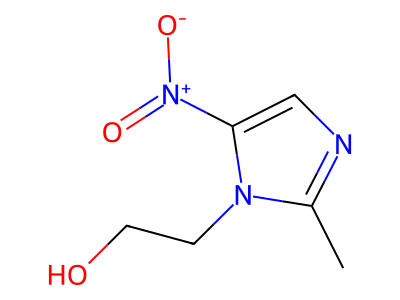
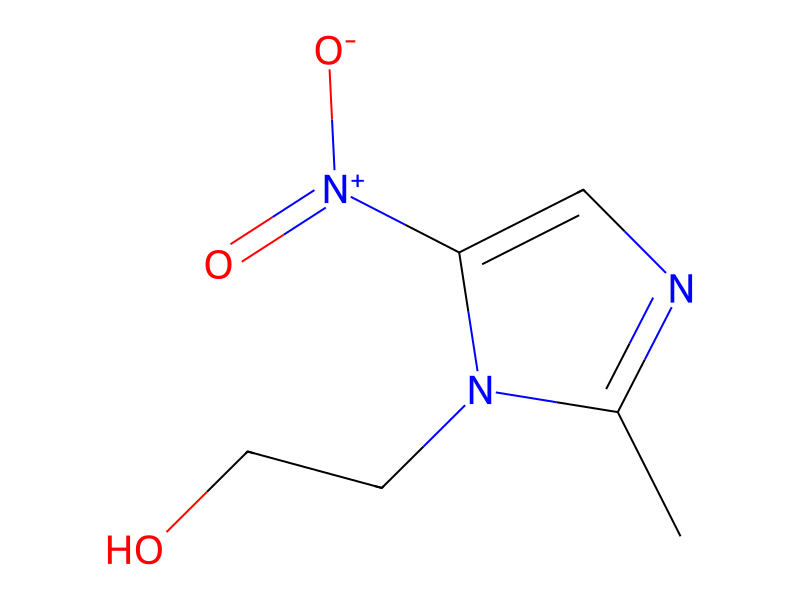
Cite this structure
Embed this structure
SMILES
Cc1ncc([N+](=O)[O-])n1CCO
InChI
InChI=1S/C6H9N3O3/c1-5-7-4-6(9(11)12)8(5)2-3-10/h4,10H,2-3H2,1H3
Molecular Formula
C6H9N3O3
HBD / HBA
1 / 4
회전 가능 결합
2
무거운 원자
12
No targets recorded
Target interaction data is not yet available for this drug.
No side effects recorded
Side effect data is not yet available for this drug.
자주 묻는 질문
This antibiotic and antiprotozoal drug kills bacteria and parasites by damaging their DNA. It is used to treat a wide range of infections including those of the digestive tract, reproductive system, and skin.
Key pharmacokinetic parameters for Metronidazole: Half-life: 8 hours.
Yes, Metronidazole is an approved drug. It has reached clinical phase 4. It is classified as a Small molecule.
Related Drugs
References & Data Sources
- ChEMBL — European Bioinformatics Institute (EBI). CHEMBL137. Open-access bioactivity database.
- PubChem — National Center for Biotechnology Information (NCBI). CID 4173. Chemical information database.
Data aggregated from publicly available pharmacological databases. Last updated 2026-08-20.
Embed This Widget
Add the script tag and a data attribute to embed this widget.
<script src="https://cdn.jsdelivr.net/npm/drugfyi-embed@1/dist/embed.min.js" defer></script>
<div data-drugfyi="drug" data-slug="metronidazole"></div>Embed via iframe for maximum compatibility.
<iframe src="https://drugfyi.com/iframe/drug/metronidazole/" width="420" height="400" frameborder="0" style="border:0;border-radius:10px;max-width:100%" loading="lazy"></iframe>Paste this URL in WordPress, Medium, or any oEmbed-compatible platform.
https://drugfyi.com/drug/metronidazole/Add a dynamic SVG badge to your README or docs.
[](https://drugfyi.com/drug/metronidazole/)Use the native HTML custom element.
<script src="https://cdn.jsdelivr.net/npm/drugfyi-embed@1/dist/embed.min.js" defer></script>
<drugfyi-drug slug="metronidazole"></drugfyi-drug>