Amsacrine
A chemotherapy agent that inhibits an enzyme called topoisomerase II, which cancer cells need to unwind and copy their DNA, leading to strand breaks and cell death. It is used in the treatment of certain leukemias.
Peso Molecular
393,5000 g/mol
LogP
4,00
TPSA
88,70 Ų
Regra dos 5 de Lipinski
Aprovado
Áreas Terapêuticas
Mecanismo de Ação
Inhibits DNA topoisomerase, preventing the relaxation of supercoiled DNA during replication and transcription. This causes DNA strand breaks and triggers apoptosis in rapidly dividing cells.
Pharmacokinetics (PK)
Pharmacodynamics (PD)
Inhibits DNA topoisomerase, preventing the relaxation of supercoiled DNA during replication and transcription. This causes DNA strand breaks and triggers apoptosis in rapidly dividing cells.
Estrutura 2D
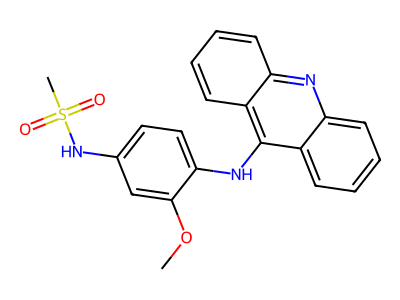
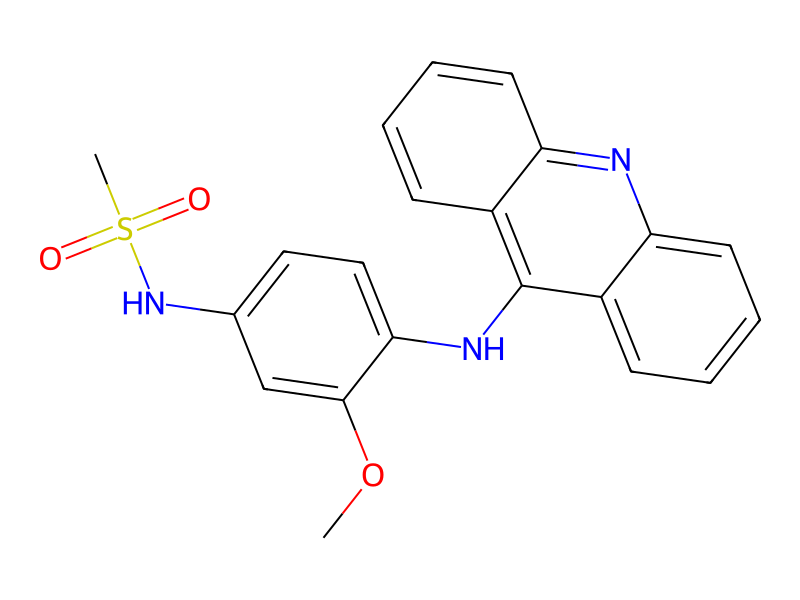
Cite this structure
Embed this structure
SMILES
COc1cc(NS(C)(=O)=O)ccc1Nc1c2ccccc2nc2ccccc12
InChI
InChI=1S/C21H19N3O3S/c1-27-20-13-14(24-28(2,25)26)11-12-19(20)23-21-15-7-3-5-9-17(15)22-18-10-6-4-8-16(18)21/h3-13,24H,1-2H3,(H,22,23)
Molecular Formula
C21H19N3O3S
HBD / HBA
2 / 6
Ligações Rotacionáveis
5
Átomos Pesados
28
No targets recorded
Target interaction data is not yet available for this drug.
No interactions recorded
Drug interaction data is not yet available for this compound.
No side effects recorded
Side effect data is not yet available for this drug.
Perguntas frequentes
A chemotherapy agent that inhibits an enzyme called topoisomerase II, which cancer cells need to unwind and copy their DNA, leading to strand breaks and cell death. It is used in the treatment of certain leukemias.
Inhibits DNA topoisomerase, preventing the relaxation of supercoiled DNA during replication and transcription. This causes DNA strand breaks and triggers apoptosis in rapidly dividing cells.
Yes, Amsacrine is an approved drug. It has reached clinical phase 4. It is classified as a Small molecule.
References & Data Sources
- ChEMBL — European Bioinformatics Institute (EBI). CHEMBL43. Open-access bioactivity database.
- PubChem — National Center for Biotechnology Information (NCBI). CID 2179. Chemical information database.
Data aggregated from publicly available pharmacological databases. Last updated 2026-03-04.
Embed This Widget
Add the script tag and a data attribute to embed this widget.
<script src="https://cdn.jsdelivr.net/npm/drugfyi-embed@1/dist/embed.min.js" defer></script>
<div data-drugfyi="drug" data-slug="amsacrine"></div>Embed via iframe for maximum compatibility.
<iframe src="https://drugfyi.com/iframe/drug/amsacrine/" width="420" height="400" frameborder="0" style="border:0;border-radius:10px;max-width:100%" loading="lazy"></iframe>Paste this URL in WordPress, Medium, or any oEmbed-compatible platform.
https://drugfyi.com/drug/amsacrine/Add a dynamic SVG badge to your README or docs.
[](https://drugfyi.com/drug/amsacrine/)Use the native HTML custom element.
<script src="https://cdn.jsdelivr.net/npm/drugfyi-embed@1/dist/embed.min.js" defer></script>
<drugfyi-drug slug="amsacrine"></drugfyi-drug>