Methotrexate
Dose defines methotrexate's dual identity. At low weekly doses it calms overactive immunity in rheumatoid arthritis, psoriasis, and Crohn's disease; at much higher doses it acts as a chemotherapy agent against certain cancers. Both effects trace to a single mechanism: inhibition of dihydrofolate reductase, the enzyme that regenerates the folate cofactors cells need to synthesize DNA and divide. Rapidly proliferating cells, whether malignant or immune, are the most affected. An antifolate small molecule (C20H22N8O5) with a half-life of about 3 to 10 hours, it is structurally modeled on folic acid, which it displaces at the enzyme. This shared pathway explains why folate status strongly influences both its benefit and its toxicity. Methotrexate is an approved medicine spanning rheumatology and oncology.
A versatile medication used at low doses to treat autoimmune conditions such as rheumatoid arthritis, psoriasis, and Crohn's disease, and at higher doses as a chemotherapy drug for certain cancers. It works by blocking folic acid metabolism, reducing cell growth and immune activity.
Peso Molecular
454,4400 g/mol
LogP
-1,80
TPSA
211,00 Ų
Regra dos 5 de Lipinski
Aprovado
Áreas Terapêuticas
Classes de Medicamentos
Pharmacokinetics (PK)
Pharmacodynamics (PD)
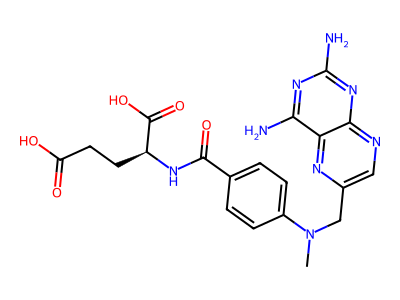
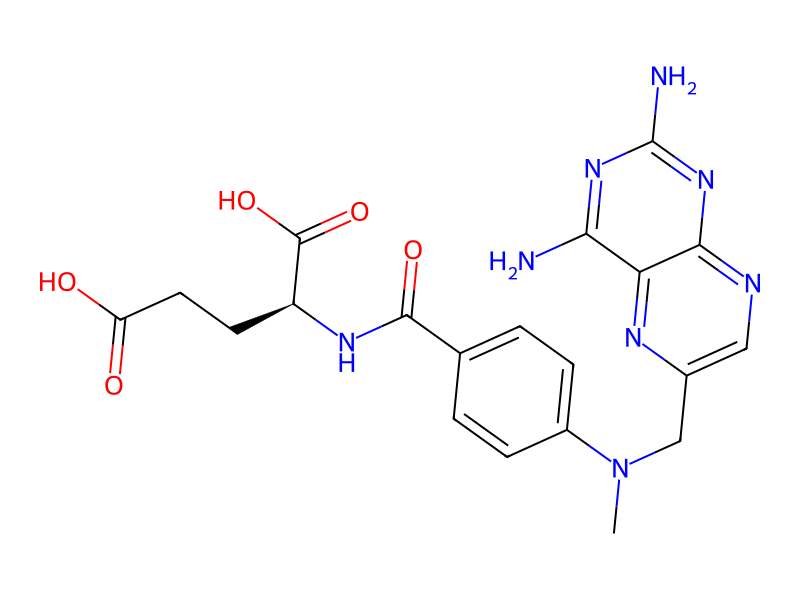
Estrutura 2D
Cite this structure
Embed this structure
SMILES
CN(Cc1cnc2nc(N)nc(N)c2n1)c1ccc(C(=O)N[C@@H](CCC(=O)O)C(=O)O)cc1
InChI
InChI=1S/C20H22N8O5/c1-28(9-11-8-23-17-15(24-11)16(21)26-20(22)27-17)12-4-2-10(3-5-12)18(31)25-13(19(32)33)6-7-14(29)30/h2-5,8,13H,6-7,9H2,1H3,(H,25,31)(H,29,30)(H,32,33)(H4,21,22,23,26,27)/t13-/m0/s1
Molecular Formula
C20H22N8O5
HBD / HBA
5 / 12
Ligações Rotacionáveis
9
Átomos Pesados
33
No targets recorded
Target interaction data is not yet available for this drug.
Methotrexate combined with warfarin increases bleeding risk and may cause enhanced anticoagulation; both drugs share protein-binding sites, amplifying free drug concentrations.
Trimethoprim and methotrexate both inhibit dihydrofolate reductase (DHFR), producing additive antifolate toxicity with potentially life-threatening pancytopenia and mucositis.
NSAIDs reduce methotrexate renal elimination, raising its plasma levels and significantly increasing the risk of methotrexate toxicity (myelosuppression, mucositis, nephrotoxicity).
Both oseltamivir carboxylate and methotrexate rely on renal tubular secretion via OAT transporters; theoretically, competition could reduce elimination of either drug, though clinical evidence of a significant interaction is limited.
Aspirin reduces methotrexate clearance by competing for renal tubular secretion, raising plasma methotrexate levels and toxicity risk.
Ibuprofen reduces methotrexate clearance and can cause severe methotrexate toxicity including life-threatening bone marrow suppression.
Dexamethasone and methotrexate are commonly combined in oncology regimens; dexamethasone may modestly reduce methotrexate's antifolate toxicity but also reduce some therapeutic activity.
Methotrexate is intentionally combined with adalimumab in rheumatoid arthritis and other autoimmune conditions to reduce adalimumab immunogenicity and improve efficacy; co-administration requires monitoring for additive immunosuppression.
Clindamycin may reduce renal tubular secretion of methotrexate, raising methotrexate levels and increasing the risk of haematological and GI toxicity.
Celecoxib may increase methotrexate exposure by reducing its renal clearance, raising the risk of toxicity in patients on MTX-based regimens.
Amoxicillin can reduce the renal clearance of methotrexate by inhibiting tubular secretion, increasing methotrexate plasma levels and risk of toxicity.
No side effects recorded
Side effect data is not yet available for this drug.
Perguntas frequentes
A versatile medication used at low doses to treat autoimmune conditions such as rheumatoid arthritis, psoriasis, and Crohn's disease, and at higher doses as a chemotherapy drug for certain cancers. It works by blocking folic acid metabolism, reducing cell growth and immune activity.
Key pharmacokinetic parameters for Methotrexate: Half-life: 3-10 hours.
Yes, Methotrexate is an approved drug. It has reached clinical phase 4. It is classified as a Small molecule.
Related Drugs
References & Data Sources
- ChEMBL — European Bioinformatics Institute (EBI). CHEMBL34259. Open-access bioactivity database.
- PubChem — National Center for Biotechnology Information (NCBI). CID 126941. Chemical information database.
Data aggregated from publicly available pharmacological databases. Last updated 2026-08-20.
Embed This Widget
Add the script tag and a data attribute to embed this widget.
<script src="https://cdn.jsdelivr.net/npm/drugfyi-embed@1/dist/embed.min.js" defer></script>
<div data-drugfyi="drug" data-slug="methotrexate"></div>Embed via iframe for maximum compatibility.
<iframe src="https://drugfyi.com/iframe/drug/methotrexate/" width="420" height="400" frameborder="0" style="border:0;border-radius:10px;max-width:100%" loading="lazy"></iframe>Paste this URL in WordPress, Medium, or any oEmbed-compatible platform.
https://drugfyi.com/drug/methotrexate/Add a dynamic SVG badge to your README or docs.
[](https://drugfyi.com/drug/methotrexate/)Use the native HTML custom element.
<script src="https://cdn.jsdelivr.net/npm/drugfyi-embed@1/dist/embed.min.js" defer></script>
<drugfyi-drug slug="methotrexate"></drugfyi-drug>