Tirbanibulin
Tirbanibulin is a first-in-class dual-mechanism antineoplastic that inhibits both tubulin polymerization (preventing microtubule assembly) and Src kinase signaling (disrupting oncogenic signaling pathways), exerting antiproliferative and anti-invasive effects in tumor cells. It is approved as a topical treatment for actinic keratosis on the face or scalp, and is being investigated for various skin cancers and hematologic malignancies including leukemia. Its dual inhibitory mechanism may overcome some mechanisms of resistance to single-target agents.
Peso Molecular
431,5000 g/mol
LogP
2,90
TPSA
63,70 Ų
Regra dos 5 de Lipinski
Aprovado
Áreas Terapêuticas
Mecanismo de Ação
Applied directly to the skin or mucous membranes, where it exerts its therapeutic effect locally at the site of application with minimal systemic absorption.
Pharmacokinetics (PK)
Pharmacodynamics (PD)
Applied directly to the skin or mucous membranes, where it exerts its therapeutic effect locally at the site of application with minimal systemic absorption.
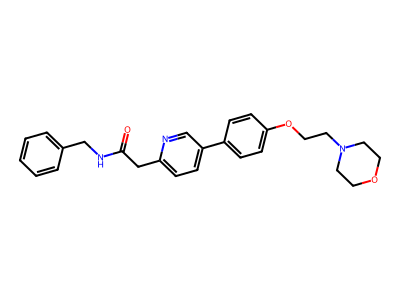
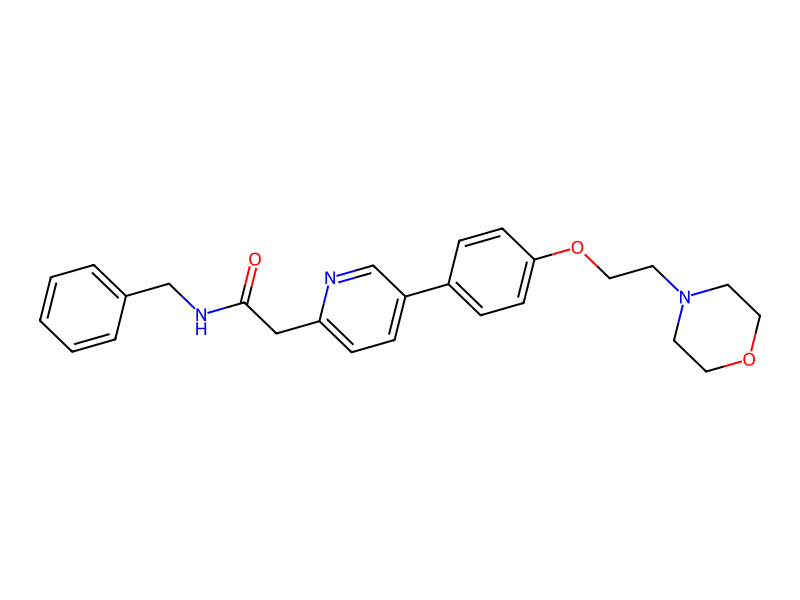
Estrutura 2D
Cite this structure
Embed this structure
SMILES
O=C(Cc1ccc(-c2ccc(OCCN3CCOCC3)cc2)cn1)NCc1ccccc1
InChI
InChI=1S/C26H29N3O3/c30-26(28-19-21-4-2-1-3-5-21)18-24-9-6-23(20-27-24)22-7-10-25(11-8-22)32-17-14-29-12-15-31-16-13-29/h1-11,20H,12-19H2,(H,28,30)
Molecular Formula
C26H29N3O3
HBD / HBA
1 / 5
Ligações Rotacionáveis
9
Átomos Pesados
32
No targets recorded
Target interaction data is not yet available for this drug.
No interactions recorded
Drug interaction data is not yet available for this compound.
No side effects recorded
Side effect data is not yet available for this drug.
Perguntas frequentes
Tirbanibulin is a first-in-class dual-mechanism antineoplastic that inhibits both tubulin polymerization (preventing microtubule assembly) and Src kinase signaling (disrupting oncogenic signaling pathways), exerting antiproliferative and anti-invasive effects in tumor cells. It is approved as a topical treatment for actinic keratosis on the face or scalp, and is being investigated for various skin cancers and hematologic malignancies including leukemia. Its dual inhibitory mechanism may overcome some mechanisms of resistance to single-target agents.
Applied directly to the skin or mucous membranes, where it exerts its therapeutic effect locally at the site of application with minimal systemic absorption.
Yes, Tirbanibulin is an approved drug. It has reached clinical phase 4. It is classified as a Small molecule.
References & Data Sources
- ChEMBL — European Bioinformatics Institute (EBI). CHEMBL571546. Open-access bioactivity database.
- PubChem — National Center for Biotechnology Information (NCBI). CID 23635314. Chemical information database.
Data aggregated from publicly available pharmacological databases. Last updated 2026-03-28.
Embed This Widget
Add the script tag and a data attribute to embed this widget.
<script src="https://cdn.jsdelivr.net/npm/drugfyi-embed@1/dist/embed.min.js" defer></script>
<div data-drugfyi="drug" data-slug="tirbanibulin"></div>Embed via iframe for maximum compatibility.
<iframe src="https://drugfyi.com/iframe/drug/tirbanibulin/" width="420" height="400" frameborder="0" style="border:0;border-radius:10px;max-width:100%" loading="lazy"></iframe>Paste this URL in WordPress, Medium, or any oEmbed-compatible platform.
https://drugfyi.com/drug/tirbanibulin/Add a dynamic SVG badge to your README or docs.
[](https://drugfyi.com/drug/tirbanibulin/)Use the native HTML custom element.
<script src="https://cdn.jsdelivr.net/npm/drugfyi-embed@1/dist/embed.min.js" defer></script>
<drugfyi-drug slug="tirbanibulin"></drugfyi-drug>