Acetohexamide
Sulfonylurea receptor binding on pancreatic beta cells is the starting point of acetohexamide's action: occupying SUR1 closes ATP-sensitive potassium channels, the membrane depolarises, voltage-gated calcium channels open and stored insulin is released by exocytosis. Because secretion is provoked directly rather than in response to glucose, residual beta-cell function is a prerequisite, and the drug was used in type 2 diabetes on that basis. Newer sulfonylureas and other agents with more favourable safety profiles and less tendency to cause prolonged hypoglycaemia have largely replaced it. Hypoglycaemia is the intrinsic hazard of provoking insulin release independently of the prevailing glucose concentration. The compound is C15H20N2O4S with a molecular weight of roughly 324.4 g/mol.
An older oral diabetes medication belonging to the sulfonylurea class that stimulates the pancreas to release more insulin after meals. It was used to lower blood glucose in people with type 2 diabetes whose pancreas still produces some insulin. It has largely been replaced by newer sulfonylureas and other diabetes medications with more favorable safety profiles and less risk of prolonged low blood sugar.
Khối lượng phân tử
324,4000 g/mol
LogP
2,40
TPSA
101,00 Ų
Lipinski RO5
Đạt
Lĩnh vực điều trị
Cơ chế tác dụng
Binds to the sulfonylurea receptor (SUR1) on pancreatic beta cells, closing ATP-sensitive potassium channels and triggering membrane depolarization. This opens voltage-gated calcium channels, leading to insulin exocytosis.
Pharmacokinetics (PK)
Pharmacodynamics (PD)
Binds to the sulfonylurea receptor (SUR1) on pancreatic beta cells, closing ATP-sensitive potassium channels and triggering membrane depolarization. This opens voltage-gated calcium channels, leading to insulin exocytosis.
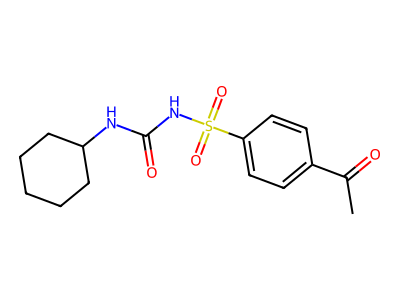
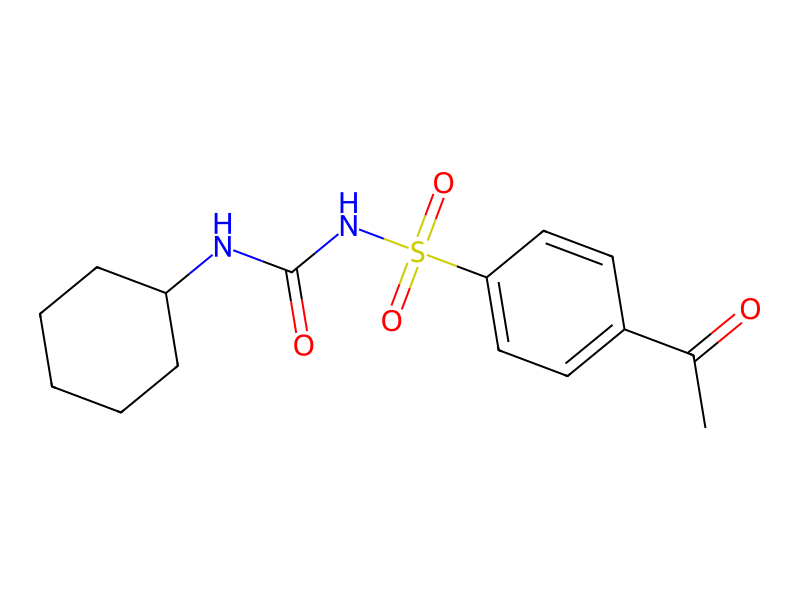
Cấu trúc 2D
Cite this structure
Embed this structure
SMILES
CC(=O)c1ccc(S(=O)(=O)NC(=O)NC2CCCCC2)cc1
InChI
InChI=1S/C15H20N2O4S/c1-11(18)12-7-9-14(10-8-12)22(20,21)17-15(19)16-13-5-3-2-4-6-13/h7-10,13H,2-6H2,1H3,(H2,16,17,19)
Molecular Formula
C15H20N2O4S
HBD / HBA
2 / 4
Liên kết có thể quay
4
Nguyên tử nặng
22
No targets recorded
Target interaction data is not yet available for this drug.
No interactions recorded
Drug interaction data is not yet available for this compound.
No side effects recorded
Side effect data is not yet available for this drug.
Câu hỏi thường gặp
An older oral diabetes medication belonging to the sulfonylurea class that stimulates the pancreas to release more insulin after meals. It was used to lower blood glucose in people with type 2 diabetes whose pancreas still produces some insulin. It has largely been replaced by newer sulfonylureas and other diabetes medications with more favorable safety profiles and less risk of prolonged low blood sugar.
Binds to the sulfonylurea receptor (SUR1) on pancreatic beta cells, closing ATP-sensitive potassium channels and triggering membrane depolarization. This opens voltage-gated calcium channels, leading to insulin exocytosis.
Yes, Acetohexamide is an approved drug. It has reached clinical phase 4. It is classified as a Small molecule.
References & Data Sources
- ChEMBL — European Bioinformatics Institute (EBI). CHEMBL1589. Open-access bioactivity database.
- PubChem — National Center for Biotechnology Information (NCBI). CID 1989. Chemical information database.
Data aggregated from publicly available pharmacological databases. Last updated 2026-08-20.
Embed This Widget
Add the script tag and a data attribute to embed this widget.
<script src="https://cdn.jsdelivr.net/npm/drugfyi-embed@1/dist/embed.min.js" defer></script>
<div data-drugfyi="drug" data-slug="acetohexamide"></div>Embed via iframe for maximum compatibility.
<iframe src="https://drugfyi.com/iframe/drug/acetohexamide/" width="420" height="400" frameborder="0" style="border:0;border-radius:10px;max-width:100%" loading="lazy"></iframe>Paste this URL in WordPress, Medium, or any oEmbed-compatible platform.
https://drugfyi.com/drug/acetohexamide/Add a dynamic SVG badge to your README or docs.
<a href="https://drugfyi.com/drug/acetohexamide/" rel="nofollow noopener"><img src="https://drugfyi.com/badge/entity/acetohexamide.svg" alt="DrugFYI"></a>Use the native HTML custom element.
<script src="https://cdn.jsdelivr.net/npm/drugfyi-embed@1/dist/embed.min.js" defer></script>
<drugfyi-drug slug="acetohexamide"></drugfyi-drug>