Hydrochlorothiazide
Hydrochlorothiazide is a thiazide diuretic that acts in the kidney's distal convoluted tubule, where it blocks the sodium-chloride cotransporter to increase salt and water excretion. Beyond the initial fluid loss, longer-term use also relaxes blood vessels, and both effects contribute to its role in lowering blood pressure. It is used alone or combined with other antihypertensives, and for the edema of heart failure; by reducing urinary calcium it can also help prevent certain kidney stones. A sulfonamide-based small molecule (C7H8ClN3O4S2) with a half-life of about 6 to 15 hours, it is one of the most established blood-pressure medications. Its effect on ion handling can lower potassium, so electrolyte balance is watched during therapy. Hydrochlorothiazide is an approved agent widely used in hypertension management.
A thiazide diuretic that lowers blood pressure by reducing fluid volume through increased urine output and by relaxing blood vessels, widely used alone or in combination with other antihypertensives to treat high blood pressure, heart failure, and edema. It is also used to prevent kidney stones in patients with high urinary calcium. Potassium levels should be monitored as this medication can cause hypokalemia.
Khối lượng phân tử
297,7400 g/mol
LogP
-0,10
TPSA
135,00 Ų
Lipinski RO5
Đạt
Lĩnh vực điều trị
Phân loại thuốc
Cơ chế tác dụng
Inhibits Na+/Cl- cotransporter in distal convoluted tubule.
Pharmacokinetics (PK)
Pharmacodynamics (PD)
Inhibits Na+/Cl- cotransporter in distal convoluted tubule.
Cấu trúc 2D
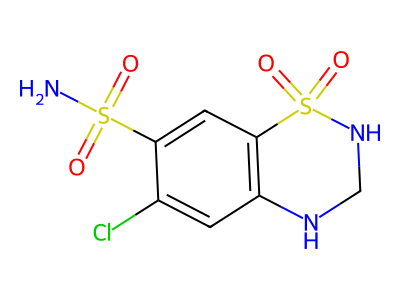
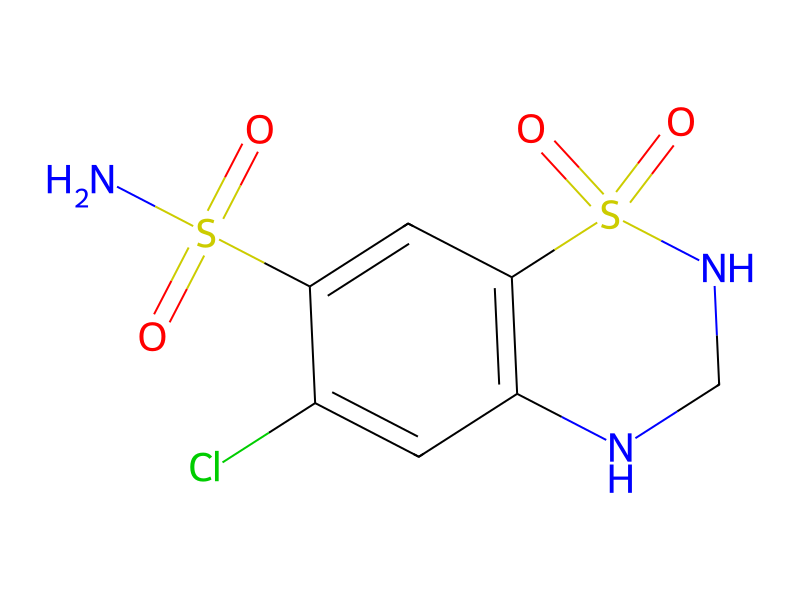
Cite this structure
Embed this structure
SMILES
NS(=O)(=O)c1cc2c(cc1Cl)NCNS2(=O)=O
InChI
InChI=1S/C7H8ClN3O4S2/c8-4-1-5-7(2-6(4)16(9,12)13)17(14,15)11-3-10-5/h1-2,10-11H,3H2,(H2,9,12,13)
Molecular Formula
C7H8ClN3O4S2
HBD / HBA
3 / 7
Liên kết có thể quay
1
Nguyên tử nặng
17
No targets recorded
Target interaction data is not yet available for this drug.
Thiazide diuretics increase lithium reabsorption in the proximal renal tubule, reliably causing lithium toxicity without dose adjustment.
The ACE inhibitor and thiazide combination is guideline-recommended for hypertension but can cause first-dose hypotension and metabolic disturbances including hypokalemia or hyperkalemia.
Losartan + hydrochlorothiazide is a guideline-recommended combination for hypertension; the primary interactions are additive hypotension and variable electrolyte effects.
Hydrochlorothiazide may reduce renal clearance of memantine through alkalinisation of urine, as memantine elimination is pH-dependent; the clinical impact is generally minor.
Naproxen reduces the diuretic and antihypertensive efficacy of thiazide diuretics, blunting blood pressure control.
Hydrochlorothiazide-induced sodium and fluid loss can increase the risk of dizziness and orthostatic hypotension when combined with gabapentin, which also causes dizziness and impairs balance.
Sequential nephron blockade with furosemide and thiazide diuretics produces a synergistic diuretic effect that can rapidly cause severe hypovolemia, hyponatremia, and hypokalemia.
The combination of empagliflozin and hydrochlorothiazide can cause additive volume depletion and hypotension, and may also increase the risk of genital mycotic infections through shared glucosuria.
No side effects recorded
Side effect data is not yet available for this drug.
Câu hỏi thường gặp
A thiazide diuretic that lowers blood pressure by reducing fluid volume through increased urine output and by relaxing blood vessels, widely used alone or in combination with other antihypertensives to treat high blood pressure, heart failure, and edema. It is also used to prevent kidney stones in patients with high urinary calcium. Potassium levels should be monitored as this medication can cause hypokalemia.
Inhibits Na+/Cl- cotransporter in distal convoluted tubule.
Key pharmacokinetic parameters for Hydrochlorothiazide: Half-life: 6-15 hours.
Yes, Hydrochlorothiazide is an approved drug. It has reached clinical phase 4. It is classified as a Small molecule.
Related Drugs
References & Data Sources
- ChEMBL — European Bioinformatics Institute (EBI). CHEMBL435. Open-access bioactivity database.
- PubChem — National Center for Biotechnology Information (NCBI). CID 3639. Chemical information database.
Data aggregated from publicly available pharmacological databases. Last updated 2026-03-04.
Embed This Widget
Add the script tag and a data attribute to embed this widget.
<script src="https://cdn.jsdelivr.net/npm/drugfyi-embed@1/dist/embed.min.js" defer></script>
<div data-drugfyi="drug" data-slug="hydrochlorothiazide"></div>Embed via iframe for maximum compatibility.
<iframe src="https://drugfyi.com/iframe/drug/hydrochlorothiazide/" width="420" height="400" frameborder="0" style="border:0;border-radius:10px;max-width:100%" loading="lazy"></iframe>Paste this URL in WordPress, Medium, or any oEmbed-compatible platform.
https://drugfyi.com/drug/hydrochlorothiazide/Add a dynamic SVG badge to your README or docs.
<a href="https://drugfyi.com/drug/hydrochlorothiazide/" rel="nofollow noopener"><img src="https://drugfyi.com/badge/entity/hydrochlorothiazide.svg" alt="DrugFYI"></a>Use the native HTML custom element.
<script src="https://cdn.jsdelivr.net/npm/drugfyi-embed@1/dist/embed.min.js" defer></script>
<drugfyi-drug slug="hydrochlorothiazide"></drugfyi-drug>