Carvedilol
Combining beta-adrenergic blockade with alpha-1 blocking activity, carvedilol both slows the heart and dilates blood vessels, reducing the heart's workload from two directions. It treats heart failure, hypertension, and left ventricular dysfunction after a heart attack. Marketed as Coreg, it has the formula C24H26N2O4. This dual receptor action distinguishes it from conventional beta-blockers and underlies its established role in chronic heart failure.
A nonselective beta-adrenergic blocker that also has alpha-1 blocking activity, providing vasodilation in addition to reducing heart rate and contractility. It is used to treat heart failure, hypertension, and left ventricular dysfunction following a heart attack. Its dual receptor blockade distinguishes it from conventional beta-blockers.
分子量
406.4740 g/mol
LogP
4.20
TPSA
75.70 Ų
Lipinski 五规则
符合
治疗领域
药物分类
作用机制
Non-selective beta-blocker with alpha-1 blocking activity.
Pharmacokinetics (PK)
Pharmacodynamics (PD)
Non-selective beta-blocker with alpha-1 blocking activity.
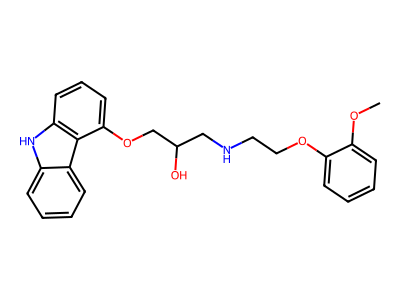
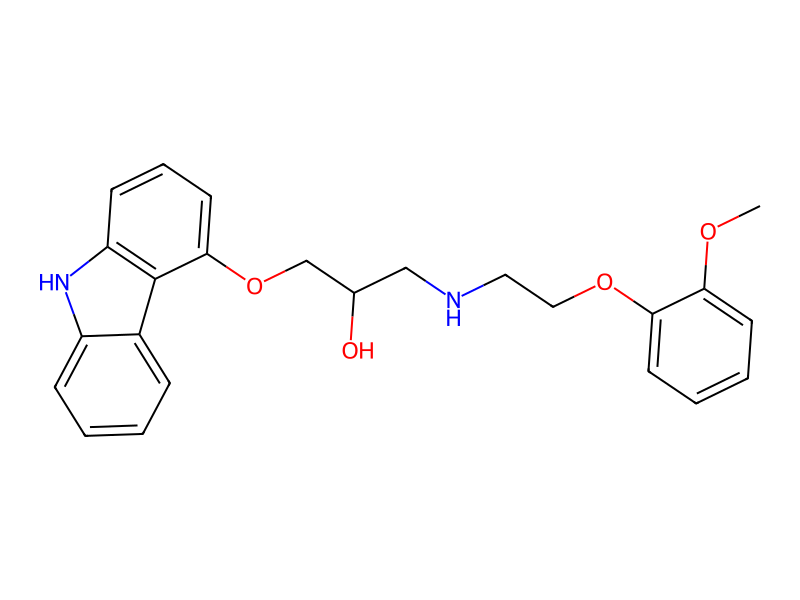
二维结构
Cite this structure
Embed this structure
SMILES
COc1ccccc1OCCNCC(O)COc1cccc2[nH]c3ccccc3c12
InChI
InChI=1S/C24H26N2O4/c1-28-21-10-4-5-11-22(21)29-14-13-25-15-17(27)16-30-23-12-6-9-20-24(23)18-7-2-3-8-19(18)26-20/h2-12,17,25-27H,13-16H2,1H3
Molecular Formula
C24H26N2O4
HBD / HBA
3 / 5
可旋转键数
10
重原子数
30
Combined use of carvedilol and lisinopril in heart failure is guideline-recommended but carries additive hypotensive risk, particularly with initiation or dose uptitration.
Carvedilol combined with diltiazem increases the risk of bradycardia, hypotension, and AV block through additive cardiac depressant effects and pharmacokinetic interaction.
Carvedilol increases digoxin plasma concentrations through P-gp inhibition and adds negative chronotropic and dromotropic effects, increasing the risk of bradycardia and AV block.
No side effects recorded
Side effect data is not yet available for this drug.
常见问题
A nonselective beta-adrenergic blocker that also has alpha-1 blocking activity, providing vasodilation in addition to reducing heart rate and contractility. It is used to treat heart failure, hypertension, and left ventricular dysfunction following a heart attack. Its dual receptor blockade distinguishes it from conventional beta-blockers.
Non-selective beta-blocker with alpha-1 blocking activity.
Key pharmacokinetic parameters for Carvedilol: Half-life: 7-10 hours.
Yes, Carvedilol is an approved drug. It has reached clinical phase 4. It is classified as a Small molecule.
Related Drugs
Same Drug Class
References & Data Sources
- ChEMBL — European Bioinformatics Institute (EBI). CHEMBL723. Open-access bioactivity database.
- PubChem — National Center for Biotechnology Information (NCBI). CID 2585. Chemical information database.
Data aggregated from publicly available pharmacological databases. Last updated 2026-03-04.
Embed This Widget
Add the script tag and a data attribute to embed this widget.
<script src="https://cdn.jsdelivr.net/npm/drugfyi-embed@1/dist/embed.min.js" defer></script>
<div data-drugfyi="drug" data-slug="carvedilol"></div>Embed via iframe for maximum compatibility.
<iframe src="https://drugfyi.com/iframe/drug/carvedilol/" width="420" height="400" frameborder="0" style="border:0;border-radius:10px;max-width:100%" loading="lazy"></iframe>Paste this URL in WordPress, Medium, or any oEmbed-compatible platform.
https://drugfyi.com/drug/carvedilol/Add a dynamic SVG badge to your README or docs.
[](https://drugfyi.com/drug/carvedilol/)Use the native HTML custom element.
<script src="https://cdn.jsdelivr.net/npm/drugfyi-embed@1/dist/embed.min.js" defer></script>
<drugfyi-drug slug="carvedilol"></drugfyi-drug>