Lamotrigine
An anticonvulsant and mood stabilizer, lamotrigine blocks voltage-gated sodium channels and curbs the release of the excitatory neurotransmitter glutamate. It treats several forms of epilepsy and is widely used to prevent depressive episodes in bipolar disorder. Marketed as Lamictal, the compound has the formula C9H7Cl2N5. Treatment is started with slow dose escalation because rapid increases raise the risk of a serious skin reaction.
An anticonvulsant and mood stabilizer used to treat epilepsy and bipolar disorder, and studied for potential benefits in Alzheimer's disease. It works by blocking voltage-gated sodium channels and reducing the release of excitatory neurotransmitters.
Molecular Weight
256.0910 g/mol
LogP
1.40
TPSA
90.70 Ų
Lipinski RO5
Pass
Therapeutic Areas
Drug Classes
Mechanism of Action
Sodium channel blocker inhibiting glutamate release.
Pharmacokinetics (PK)
Pharmacodynamics (PD)
Sodium channel blocker inhibiting glutamate release.
2D Structure
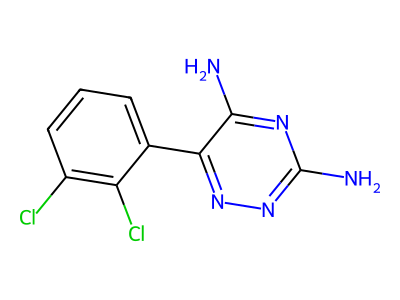
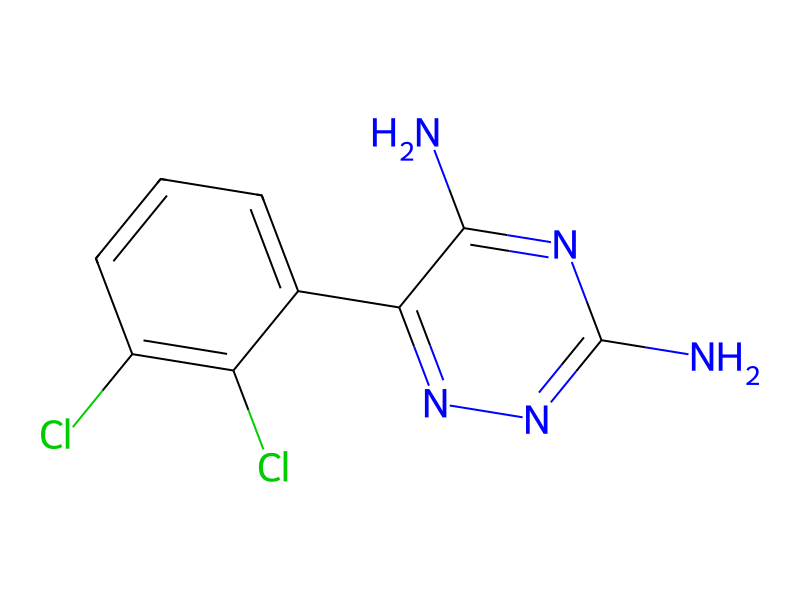
Cite this structure
Embed this structure
SMILES
Nc1nnc(-c2cccc(Cl)c2Cl)c(N)n1
InChI
InChI=1S/C9H7Cl2N5/c10-5-3-1-2-4(6(5)11)7-8(12)14-9(13)16-15-7/h1-3H,(H4,12,13,14,16)
Molecular Formula
C9H7Cl2N5
HBD / HBA
2 / 5
Rotatable Bonds
1
Heavy Atoms
16
No targets recorded
Target interaction data is not yet available for this drug.
Valproic acid doubles lamotrigine plasma concentrations by inhibiting its glucuronidation; the combination is associated with Stevens-Johnson syndrome and toxic epidermal necrolysis.
Sertraline may increase lamotrigine plasma concentrations by inhibiting its glucuronidation, potentially causing lamotrigine toxicity.
Repeated acetaminophen use may modestly lower lamotrigine plasma levels through induction of UGT glucuronidation pathways, though the clinical impact is generally small.
Carbamazepine reduces lamotrigine plasma concentrations by approximately 50% through enzyme induction, requiring lamotrigine dose adjustment.
No side effects recorded
Side effect data is not yet available for this drug.
Frequently Asked Questions
An anticonvulsant and mood stabilizer used to treat epilepsy and bipolar disorder, and studied for potential benefits in Alzheimer's disease. It works by blocking voltage-gated sodium channels and reducing the release of excitatory neurotransmitters.
Sodium channel blocker inhibiting glutamate release.
Key pharmacokinetic parameters for Lamotrigine: Half-life: 25 hours.
Yes, Lamotrigine is an approved drug. It has reached clinical phase 4. It is classified as a Small molecule.
Related Drugs
References & Data Sources
- ChEMBL — European Bioinformatics Institute (EBI). CHEMBL741. Open-access bioactivity database.
- PubChem — National Center for Biotechnology Information (NCBI). CID 3878. Chemical information database.
Data aggregated from publicly available pharmacological databases. Last updated 2026-03-04.
Embed This Widget
Add the script tag and a data attribute to embed this widget.
<script src="https://cdn.jsdelivr.net/npm/drugfyi-embed@1/dist/embed.min.js" defer></script>
<div data-drugfyi="drug" data-slug="lamotrigine"></div>Embed via iframe for maximum compatibility.
<iframe src="https://drugfyi.com/iframe/drug/lamotrigine/" width="420" height="400" frameborder="0" style="border:0;border-radius:10px;max-width:100%" loading="lazy"></iframe>Paste this URL in WordPress, Medium, or any oEmbed-compatible platform.
https://drugfyi.com/drug/lamotrigine/Add a dynamic SVG badge to your README or docs.
<a href="https://drugfyi.com/drug/lamotrigine/" rel="nofollow noopener"><img src="https://drugfyi.com/badge/entity/lamotrigine.svg" alt="DrugFYI"></a>Use the native HTML custom element.
<script src="https://cdn.jsdelivr.net/npm/drugfyi-embed@1/dist/embed.min.js" defer></script>
<drugfyi-drug slug="lamotrigine"></drugfyi-drug>