Nitroglycerin
Donation of nitric oxide is the mechanism by which nitroglycerin dilates veins and arteries, relieving the chest pain that arises when myocardial blood supply falls short of demand. Venodilation reduces preload and therefore the work the heart must perform, which relieves ischaemic pain rather than removing the obstruction causing it. Onset is rapid and the effect brief: the plasma half-life is measured in one to four minutes, which is why the drug suits acute relief. Sildenafil is recorded as a major interaction, since both act on the same cyclic GMP pathway and combined use risks profound hypotension. The compound is C3H5N3O9, about 227.1 g/mol.
A fast-acting medication that widens blood vessels to quickly relieve chest pain caused by insufficient blood supply to the heart.
Molecular Weight
227.0870 g/mol
LogP
1.60
TPSA
165.00 Ų
Lipinski RO5
Pass
Drug Classes
Mechanism of Action
Nitric oxide donor causing venous and arterial vasodilation.
Pharmacokinetics (PK)
Pharmacodynamics (PD)
Nitric oxide donor causing venous and arterial vasodilation.
2D Structure
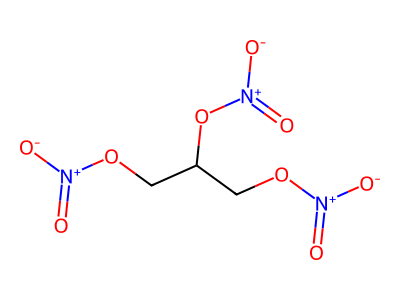
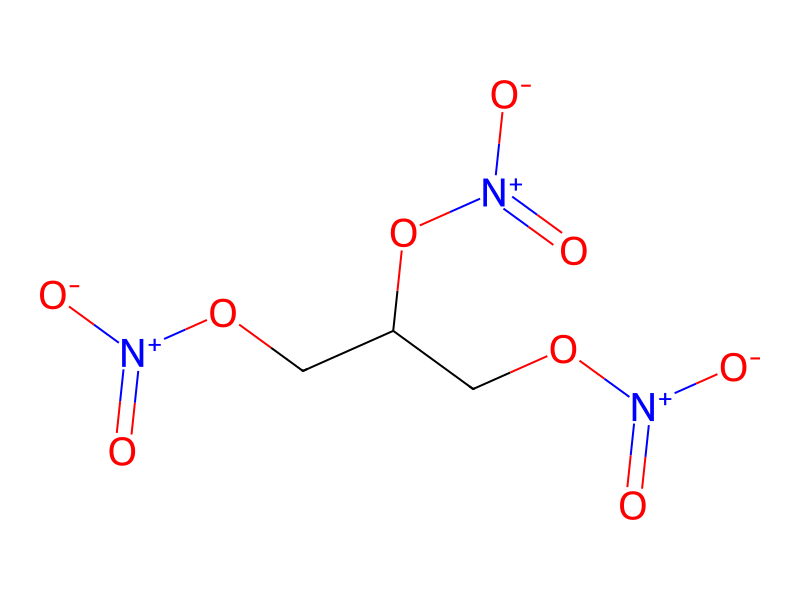
Cite this structure
Embed this structure
SMILES
O=[N+]([O-])OCC(CO[N+](=O)[O-])O[N+](=O)[O-]
InChI
InChI=1S/C3H5N3O9/c7-4(8)13-1-3(15-6(11)12)2-14-5(9)10/h3H,1-2H2
Molecular Formula
C3H5N3O9
HBD / HBA
- / 9
Rotatable Bonds
5
Heavy Atoms
15
No targets recorded
Target interaction data is not yet available for this drug.
No side effects recorded
Side effect data is not yet available for this drug.
Frequently Asked Questions
A fast-acting medication that widens blood vessels to quickly relieve chest pain caused by insufficient blood supply to the heart.
Nitric oxide donor causing venous and arterial vasodilation.
Key pharmacokinetic parameters for Nitroglycerin: Half-life: 1-4 minutes.
Yes, Nitroglycerin is an approved drug. It has reached clinical phase 4. It is classified as a Small molecule.
Related Drugs
References & Data Sources
- ChEMBL — European Bioinformatics Institute (EBI). CHEMBL730. Open-access bioactivity database.
- PubChem — National Center for Biotechnology Information (NCBI). CID 4510. Chemical information database.
Data aggregated from publicly available pharmacological databases. Last updated 2026-08-20.
Embed This Widget
Add the script tag and a data attribute to embed this widget.
<script src="https://cdn.jsdelivr.net/npm/drugfyi-embed@1/dist/embed.min.js" defer></script>
<div data-drugfyi="drug" data-slug="nitroglycerin"></div>Embed via iframe for maximum compatibility.
<iframe src="https://drugfyi.com/iframe/drug/nitroglycerin/" width="420" height="400" frameborder="0" style="border:0;border-radius:10px;max-width:100%" loading="lazy"></iframe>Paste this URL in WordPress, Medium, or any oEmbed-compatible platform.
https://drugfyi.com/drug/nitroglycerin/Add a dynamic SVG badge to your README or docs.
[](https://drugfyi.com/drug/nitroglycerin/)Use the native HTML custom element.
<script src="https://cdn.jsdelivr.net/npm/drugfyi-embed@1/dist/embed.min.js" defer></script>
<drugfyi-drug slug="nitroglycerin"></drugfyi-drug>