Sulfameter
Sulfameter is a very long-acting sulfonamide antibiotic with a plasma half-life of approximately 150 hours, used historically once or twice weekly for urinary tract infections and prevention of recurrent rheumatic fever. Its prolonged half-life results from slow renal excretion and extensive plasma protein binding. Like all sulfonamides, it inhibits bacterial dihydropteroate synthase. Its very long half-life increases the risk of cumulative sulfonamide toxicity.
분자량
280.3100 g/mol
LogP
0.40
TPSA
116.00 Ų
리핀스키 5의 법칙
통과
치료 영역
Pharmacokinetics (PK)
Pharmacodynamics (PD)
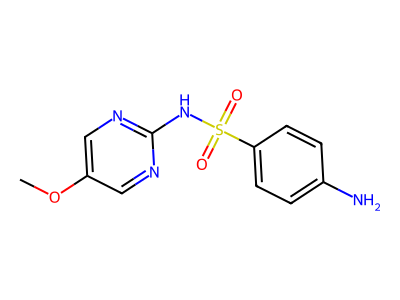
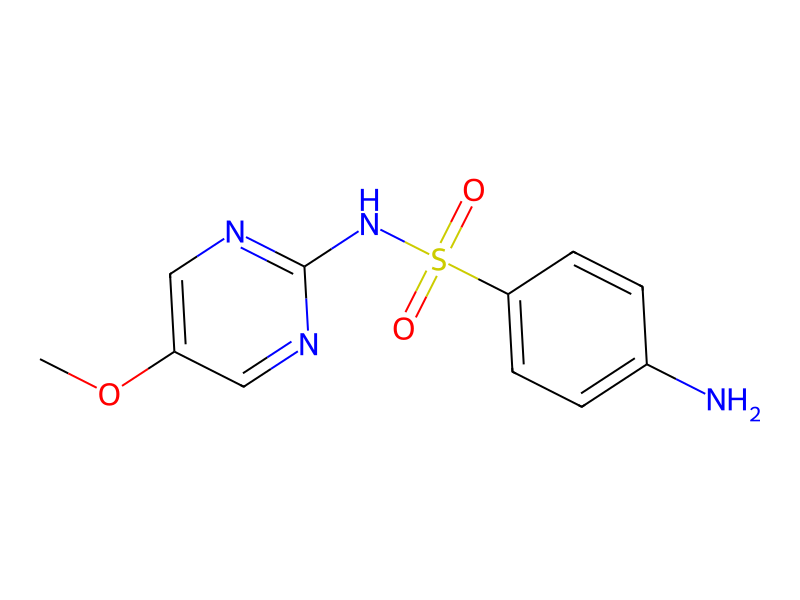
2D 구조
Cite this structure
Embed this structure
SMILES
COc1cnc(NS(=O)(=O)c2ccc(N)cc2)nc1
InChI
InChI=1S/C11H12N4O3S/c1-18-9-6-13-11(14-7-9)15-19(16,17)10-4-2-8(12)3-5-10/h2-7H,12H2,1H3,(H,13,14,15)
Molecular Formula
C11H12N4O3S
HBD / HBA
2 / 7
회전 가능 결합
4
무거운 원자
19
No targets recorded
Target interaction data is not yet available for this drug.
No interactions recorded
Drug interaction data is not yet available for this compound.
No side effects recorded
Side effect data is not yet available for this drug.
자주 묻는 질문
Sulfameter is a very long-acting sulfonamide antibiotic with a plasma half-life of approximately 150 hours, used historically once or twice weekly for urinary tract infections and prevention of recurrent rheumatic fever. Its prolonged half-life results from slow renal excretion and extensive plasma protein binding. Like all sulfonamides, it inhibits bacterial dihydropteroate synthase. Its very long half-life increases the risk of cumulative sulfonamide toxicity.
Yes, Sulfameter is an approved drug. It has reached clinical phase 4. It is classified as a Small molecule.
References & Data Sources
- ChEMBL — European Bioinformatics Institute (EBI). CHEMBL1200359. Open-access bioactivity database.
- PubChem — National Center for Biotechnology Information (NCBI). CID 5326. Chemical information database.
Data aggregated from publicly available pharmacological databases. Last updated 2026-03-28.
Embed This Widget
Add the script tag and a data attribute to embed this widget.
<script src="https://cdn.jsdelivr.net/npm/drugfyi-embed@1/dist/embed.min.js" defer></script>
<div data-drugfyi="drug" data-slug="sulfameter"></div>Embed via iframe for maximum compatibility.
<iframe src="https://drugfyi.com/iframe/drug/sulfameter/" width="420" height="400" frameborder="0" style="border:0;border-radius:10px;max-width:100%" loading="lazy"></iframe>Paste this URL in WordPress, Medium, or any oEmbed-compatible platform.
https://drugfyi.com/drug/sulfameter/Add a dynamic SVG badge to your README or docs.
[](https://drugfyi.com/drug/sulfameter/)Use the native HTML custom element.
<script src="https://cdn.jsdelivr.net/npm/drugfyi-embed@1/dist/embed.min.js" defer></script>
<drugfyi-drug slug="sulfameter"></drugfyi-drug>