Allopurinol
A xanthine oxidase inhibitor, allopurinol lowers the body's production of uric acid, preventing the crystal buildup in joints and the urinary tract that causes gout attacks and certain kidney stones. It is also used to control the surge in uric acid when chemotherapy rapidly breaks down cancer cells. Marketed as Zyloprim and Aloprim, the compound has the formula C5H4N4O.
A xanthine oxidase inhibitor that reduces the production of uric acid in the body, used primarily to prevent gout attacks and kidney stones caused by uric acid crystal buildup in joints and the urinary tract. It is also used to prevent elevated uric acid levels during cancer treatment when chemotherapy causes rapid breakdown of cancer cells.
Peso Molecular
136,1120 g/mol
LogP
-0,70
TPSA
70,10 Ų
Regra dos 5 de Lipinski
Aprovado
Áreas Terapêuticas
Classes de Medicamentos
Mecanismo de Ação
Xanthine oxidase inhibitor reducing uric acid production.
Pharmacokinetics (PK)
Pharmacodynamics (PD)
Xanthine oxidase inhibitor reducing uric acid production.
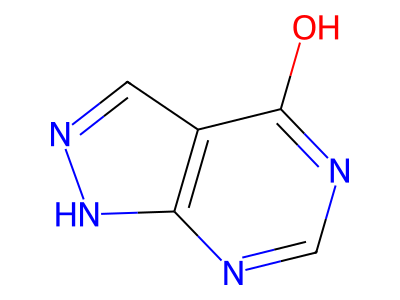
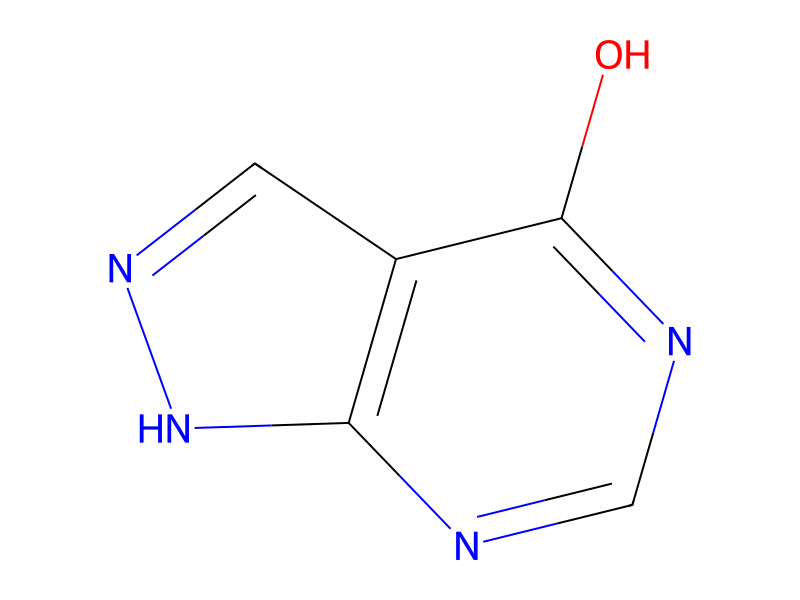
Estrutura 2D
Cite this structure
Embed this structure
SMILES
Oc1ncnc2[nH]ncc12
InChI
InChI=1S/C5H4N4O/c10-5-3-1-8-9-4(3)6-2-7-5/h1-2H,(H2,6,7,8,9,10)
Molecular Formula
C5H4N4O
HBD / HBA
2 / 3
Ligações Rotacionáveis
0
Átomos Pesados
10
No targets recorded
Target interaction data is not yet available for this drug.
The combination of allopurinol and amoxicillin is associated with a markedly increased incidence of skin rashes (primarily maculopapular), though the rash is usually non-severe and reversible.
Low-dose aspirin reduces the uricosuric effect of allopurinol and may increase uric acid levels, potentially triggering gout flares.
No side effects recorded
Side effect data is not yet available for this drug.
Perguntas frequentes
A xanthine oxidase inhibitor that reduces the production of uric acid in the body, used primarily to prevent gout attacks and kidney stones caused by uric acid crystal buildup in joints and the urinary tract. It is also used to prevent elevated uric acid levels during cancer treatment when chemotherapy causes rapid breakdown of cancer cells.
Xanthine oxidase inhibitor reducing uric acid production.
Key pharmacokinetic parameters for Allopurinol: Half-life: 1-2 hours.
Yes, Allopurinol is an approved drug. It has reached clinical phase 4. It is classified as a Small molecule.
Related Drugs
References & Data Sources
- ChEMBL — European Bioinformatics Institute (EBI). CHEMBL1467. Open-access bioactivity database.
- PubChem — National Center for Biotechnology Information (NCBI). CID 135401907. Chemical information database.
Data aggregated from publicly available pharmacological databases. Last updated 2026-03-04.
Embed This Widget
Add the script tag and a data attribute to embed this widget.
<script src="https://cdn.jsdelivr.net/npm/drugfyi-embed@1/dist/embed.min.js" defer></script>
<div data-drugfyi="drug" data-slug="allopurinol"></div>Embed via iframe for maximum compatibility.
<iframe src="https://drugfyi.com/iframe/drug/allopurinol/" width="420" height="400" frameborder="0" style="border:0;border-radius:10px;max-width:100%" loading="lazy"></iframe>Paste this URL in WordPress, Medium, or any oEmbed-compatible platform.
https://drugfyi.com/drug/allopurinol/Add a dynamic SVG badge to your README or docs.
[](https://drugfyi.com/drug/allopurinol/)Use the native HTML custom element.
<script src="https://cdn.jsdelivr.net/npm/drugfyi-embed@1/dist/embed.min.js" defer></script>
<drugfyi-drug slug="allopurinol"></drugfyi-drug>