Furosemide
Furosemide is a potent loop diuretic that acts on the kidney's ascending loop of Henle, where it blocks the sodium-potassium-chloride cotransporter responsible for reabsorbing salt. Preventing that reabsorption forces the kidney to excrete large volumes of sodium and water, rapidly relieving fluid overload. This makes it a mainstay for the edema of heart failure, liver disease, and kidney disease, and a treatment for high blood pressure. A small molecule (C12H11ClN2O5S) with a short half-life of about 2 hours, it produces a brisk, relatively brief diuresis after each dose. Its strong effect on salt handling can also lower potassium and other electrolytes, a consequence of the same transport blockade that drives water loss. Furosemide is an approved diuretic used across acute and chronic fluid-overload states.
This powerful loop diuretic reduces fluid overload by blocking sodium reabsorption in the kidney tubules, causing the kidneys to excrete more water and salt. It is widely used to treat swelling from heart failure, liver disease, and kidney disease, as well as high blood pressure.
分子量
330.7440 g/mol
LogP
2.00
TPSA
131.00 Ų
Lipinski 五规则
符合
治疗领域
药物分类
作用机制
Loop diuretic inhibiting Na-K-2Cl cotransporter.
Pharmacokinetics (PK)
Pharmacodynamics (PD)
Loop diuretic inhibiting Na-K-2Cl cotransporter.
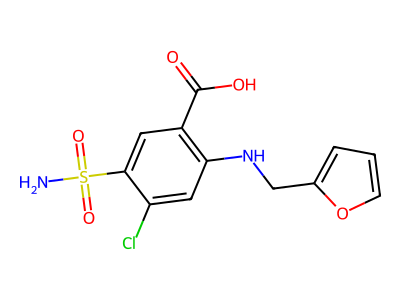
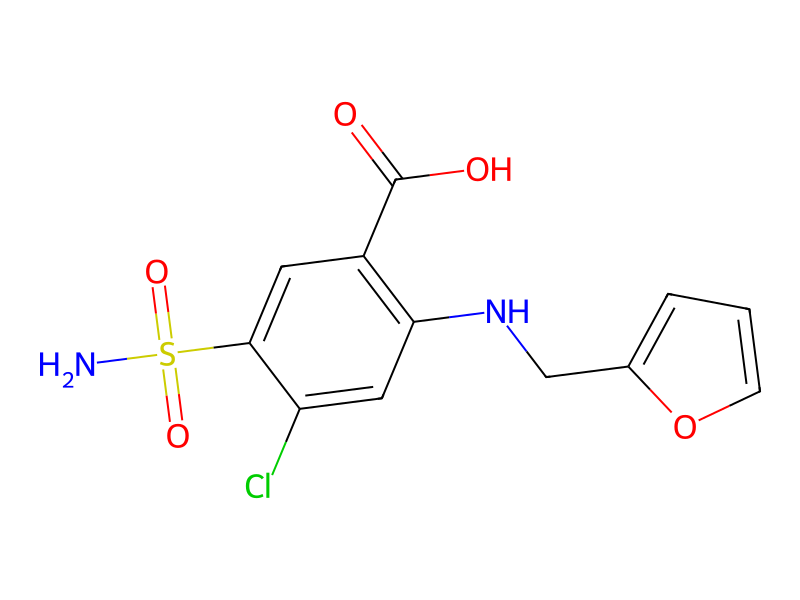
二维结构
Cite this structure
Embed this structure
SMILES
NS(=O)(=O)c1cc(C(=O)O)c(NCc2ccco2)cc1Cl
InChI
InChI=1S/C12H11ClN2O5S/c13-9-5-10(15-6-7-2-1-3-20-7)8(12(16)17)4-11(9)21(14,18)19/h1-5,15H,6H2,(H,16,17)(H2,14,18,19)
Molecular Formula
C12H11ClN2O5S
HBD / HBA
3 / 7
可旋转键数
5
重原子数
21
No targets recorded
Target interaction data is not yet available for this drug.
Furosemide-induced sodium depletion stimulates compensatory proximal tubular reabsorption of both sodium and lithium, raising lithium levels into the toxic range.
Furosemide and spironolactone have complementary diuretic mechanisms that together provide more effective decongestion in heart failure; the primary concern is unpredictable electrolyte effects.
ACE inhibitors combined with loop diuretics can cause first-dose hypotension and acute kidney injury, particularly in volume-depleted patients.
NSAIDs blunt the diuretic and antihypertensive effects of furosemide and may precipitate acute kidney injury through reduced renal perfusion.
Furosemide can increase metformin plasma concentrations and potentially contribute to lactic acidosis by reducing renal function; furosemide also impairs glucose metabolism and may worsen glycaemic control.
Sequential nephron blockade with furosemide and thiazide diuretics produces a synergistic diuretic effect that can rapidly cause severe hypovolemia, hyponatremia, and hypokalemia.
Naproxen reduces the diuretic response to furosemide by inhibiting prostaglandin synthesis, potentially causing fluid retention and worsening edema or heart failure.
Furosemide-induced hypokalemia and hypomagnesemia increase the risk of digoxin toxicity even when digoxin levels remain within the conventional therapeutic range.
Both empagliflozin and furosemide promote natriuresis and diuresis; concurrent use can produce additive volume depletion, hypotension, and electrolyte disturbances.
No side effects recorded
Side effect data is not yet available for this drug.
常见问题
This powerful loop diuretic reduces fluid overload by blocking sodium reabsorption in the kidney tubules, causing the kidneys to excrete more water and salt. It is widely used to treat swelling from heart failure, liver disease, and kidney disease, as well as high blood pressure.
Loop diuretic inhibiting Na-K-2Cl cotransporter.
Key pharmacokinetic parameters for Furosemide: Half-life: 2 hours.
Yes, Furosemide is an approved drug. It has reached clinical phase 4. It is classified as a Small molecule.
Related Drugs
References & Data Sources
- ChEMBL — European Bioinformatics Institute (EBI). CHEMBL35. Open-access bioactivity database.
- PubChem — National Center for Biotechnology Information (NCBI). CID 3440. Chemical information database.
Data aggregated from publicly available pharmacological databases. Last updated 2026-03-04.
Embed This Widget
Add the script tag and a data attribute to embed this widget.
<script src="https://cdn.jsdelivr.net/npm/drugfyi-embed@1/dist/embed.min.js" defer></script>
<div data-drugfyi="drug" data-slug="furosemide"></div>Embed via iframe for maximum compatibility.
<iframe src="https://drugfyi.com/iframe/drug/furosemide/" width="420" height="400" frameborder="0" style="border:0;border-radius:10px;max-width:100%" loading="lazy"></iframe>Paste this URL in WordPress, Medium, or any oEmbed-compatible platform.
https://drugfyi.com/drug/furosemide/Add a dynamic SVG badge to your README or docs.
<a href="https://drugfyi.com/drug/furosemide/" rel="nofollow noopener"><img src="https://drugfyi.com/badge/entity/furosemide.svg" alt="DrugFYI"></a>Use the native HTML custom element.
<script src="https://cdn.jsdelivr.net/npm/drugfyi-embed@1/dist/embed.min.js" defer></script>
<drugfyi-drug slug="furosemide"></drugfyi-drug>