Ibuprofen
A nonsteroidal anti-inflammatory drug, ibuprofen relieves pain, lowers fever, and reduces inflammation by inhibiting the cyclooxygenase enzymes that manufacture prostaglandins. Because it blocks both COX-1 and COX-2 without preference, it eases symptoms broadly but can also affect the stomach lining and kidneys that depend on COX-1 activity. Common uses include headache, dental and menstrual pain, arthritis, and minor musculoskeletal injury. A small molecule (C13H18O2) with a short half-life of 2 to 4 hours, it is cleared quickly, which is why repeated daily doses are typical for sustained relief. Prolonged high-dose exposure raises the likelihood of gastrointestinal ulceration, renal impairment, and cardiovascular events, reflecting the same prostaglandin suppression that produces the benefit. Ibuprofen is an approved analgesic available both over the counter and by prescription.
This widely used nonsteroidal anti-inflammatory drug (NSAID) relieves pain, reduces fever, and decreases inflammation by blocking cyclooxygenase (COX) enzymes that produce prostaglandins. It is used for headaches, dental pain, arthritis, menstrual cramps, and minor injuries. Prolonged use at high doses can increase the risk of stomach ulcers, kidney problems, and cardiovascular events.
Masse moléculaire
206,2810 g/mol
LogP
3,50
TPSA
37,30 Ų
Règle des 5 de Lipinski
Conforme
Aires thérapeutiques
Classes de médicaments
Mécanisme d'action
Non-selective COX inhibitor reducing prostaglandin synthesis.
Pharmacokinetics (PK)
Pharmacodynamics (PD)
Non-selective COX inhibitor reducing prostaglandin synthesis.
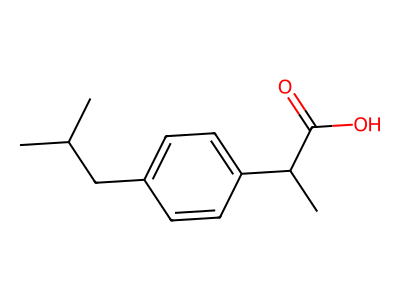
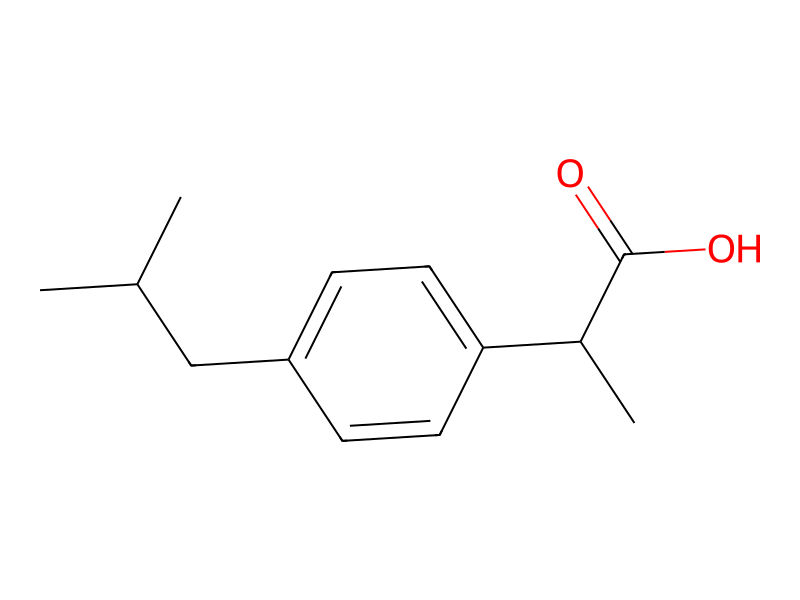
Structure 2D
Cite this structure
Embed this structure
SMILES
CC(C)Cc1ccc(C(C)C(=O)O)cc1
InChI
InChI=1S/C13H18O2/c1-9(2)8-11-4-6-12(7-5-11)10(3)13(14)15/h4-7,9-10H,8H2,1-3H3,(H,14,15)
Molecular Formula
C13H18O2
HBD / HBA
1 / 2
Liaisons Rotatives
4
Atomes Lourds
15
Ibuprofen reduces methotrexate clearance and can cause severe methotrexate toxicity including life-threatening bone marrow suppression.
NSAIDs markedly increase lithium plasma levels, potentially causing lithium toxicity (tremor, ataxia, confusion, cardiac arrhythmias).
Ibuprofen combined with warfarin substantially increases bleeding risk, particularly gastrointestinal hemorrhage, through complementary antiplatelet and mucosal injury mechanisms.
NSAIDs reduce the antihypertensive and renoprotective efficacy of ACE inhibitors and can precipitate acute kidney injury, particularly in volume-depleted or elderly patients.
Ibuprofen reduces the diuretic and antihypertensive efficacy of spironolactone and may exacerbate renal insufficiency in high-risk patients.
Combining ibuprofen with corticosteroids dramatically increases the risk of GI ulcers and hemorrhage beyond the risk of either agent alone.
Ibuprofen attenuates the antihypertensive effect of ARBs and increases the risk of renal impairment and hyperkalemia.
Ibuprofen combined with SSRIs markedly increases the risk of GI bleeding through synergistic impairment of platelet function and gastric mucosal defense.
NSAIDs combined with apixaban significantly elevate the risk of GI and other bleeding through additive effects on hemostasis and gastric mucosal injury.
Ibuprofen with dabigatran increases GI bleeding risk through additive effects; dabigatran itself carries a higher inherent GI bleeding risk than other DOACs.
NSAIDs blunt the diuretic and antihypertensive effects of furosemide and may precipitate acute kidney injury through reduced renal perfusion.
Ibuprofen can block aspirin's irreversible platelet inhibition by competing for the same COX-1 active site, potentially reducing aspirin's cardioprotective effect.
No side effects recorded
Side effect data is not yet available for this drug.
Foire aux questions
This widely used nonsteroidal anti-inflammatory drug (NSAID) relieves pain, reduces fever, and decreases inflammation by blocking cyclooxygenase (COX) enzymes that produce prostaglandins. It is used for headaches, dental pain, arthritis, menstrual cramps, and minor injuries. Prolonged use at high doses can increase the risk of stomach ulcers, kidney problems, and cardiovascular events.
Non-selective COX inhibitor reducing prostaglandin synthesis.
Key pharmacokinetic parameters for Ibuprofen: Half-life: 2-4 hours.
Yes, Ibuprofen is an approved drug. It has reached clinical phase 4. It is classified as a Small molecule.
Related Drugs
Same Drug Class
References & Data Sources
- ChEMBL — European Bioinformatics Institute (EBI). CHEMBL521. Open-access bioactivity database.
- PubChem — National Center for Biotechnology Information (NCBI). CID 3672. Chemical information database.
Data aggregated from publicly available pharmacological databases. Last updated 2026-03-04.
Embed This Widget
Add the script tag and a data attribute to embed this widget.
<script src="https://cdn.jsdelivr.net/npm/drugfyi-embed@1/dist/embed.min.js" defer></script>
<div data-drugfyi="drug" data-slug="ibuprofen"></div>Embed via iframe for maximum compatibility.
<iframe src="https://drugfyi.com/iframe/drug/ibuprofen/" width="420" height="400" frameborder="0" style="border:0;border-radius:10px;max-width:100%" loading="lazy"></iframe>Paste this URL in WordPress, Medium, or any oEmbed-compatible platform.
https://drugfyi.com/drug/ibuprofen/Add a dynamic SVG badge to your README or docs.
[](https://drugfyi.com/drug/ibuprofen/)Use the native HTML custom element.
<script src="https://cdn.jsdelivr.net/npm/drugfyi-embed@1/dist/embed.min.js" defer></script>
<drugfyi-drug slug="ibuprofen"></drugfyi-drug>