Quetiapine
An atypical antipsychotic, quetiapine works by antagonizing several neurotransmitter receptors, rebalancing dopamine and serotonin signaling to ease psychotic symptoms and stabilize mood. This broad receptor activity distinguishes the second-generation antipsychotics from older agents that block dopamine more narrowly. It treats schizophrenia and bipolar disorder and serves as an add-on for depression, and it has been studied for behavioral symptoms in dementia. Structurally a dibenzothiazepine (C21H25N3O2S), it has a relatively short half-life of about 6 hours, so sustained effect often relies on divided or extended-release dosing. Its receptor breadth accounts for both its calming, sedating quality and a side-effect profile that includes metabolic changes. Quetiapine is an approved medicine used across several psychiatric indications.
An atypical antipsychotic medication used to treat symptoms of schizophrenia, bipolar disorder, and as an add-on treatment for depression, and has also been studied for managing certain behavioral symptoms in Alzheimer's disease. It works by balancing dopamine and serotonin activity in the brain to help stabilize mood and reduce psychotic symptoms.
Masse moléculaire
383,5100 g/mol
LogP
2,10
TPSA
73,60 Ų
Règle des 5 de Lipinski
Conforme
Aires thérapeutiques
Classes de médicaments
Mécanisme d'action
Atypical antipsychotic; antagonist at multiple receptors.
Pharmacokinetics (PK)
Pharmacodynamics (PD)
Atypical antipsychotic; antagonist at multiple receptors.
Structure 2D
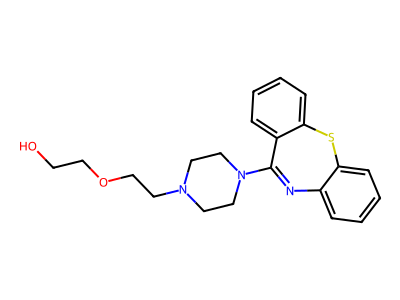
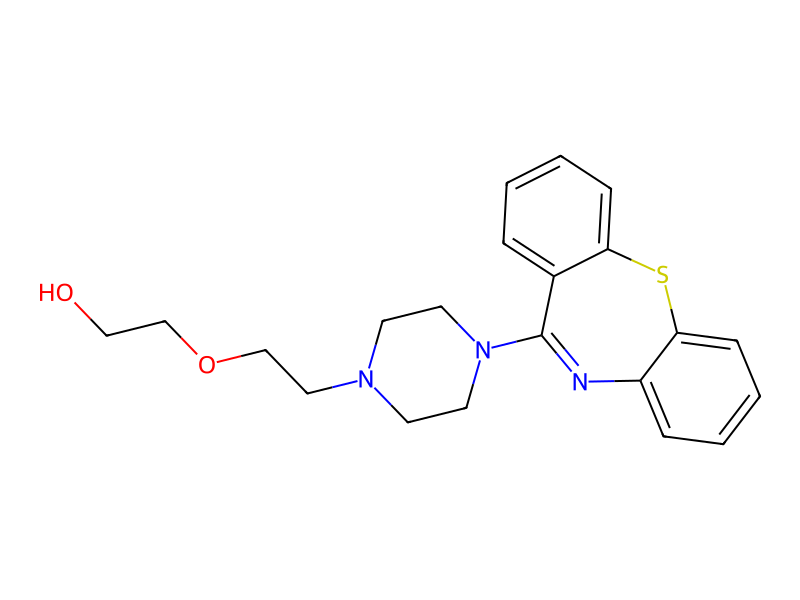
Cite this structure
Embed this structure
SMILES
OCCOCCN1CCN(C2=Nc3ccccc3Sc3ccccc32)CC1
InChI
InChI=1S/C21H25N3O2S/c25-14-16-26-15-13-23-9-11-24(12-10-23)21-17-5-1-3-7-19(17)27-20-8-4-2-6-18(20)22-21/h1-8,25H,9-16H2
Molecular Formula
C21H25N3O2S
HBD / HBA
1 / 5
Liaisons Rotatives
6
Atomes Lourds
27
Quetiapine substantially potentiates oxycodone-induced CNS and respiratory depression, and both drugs prolong the QT interval.
Co-administration of alprazolam and quetiapine produces additive CNS depression with risk of profound sedation and respiratory compromise.
Diazepam and quetiapine together significantly increase CNS depression and carry risk of severe sedation and cardiorespiratory compromise.
Fluconazole substantially increases quetiapine plasma concentrations via CYP3A4 inhibition, raising the risk of quetiapine-mediated QT prolongation and torsades de pointes.
Azithromycin and quetiapine both prolong the QT interval via hERG blockade; concurrent use significantly increases the risk of life-threatening arrhythmias.
Escitalopram and quetiapine both prolong the QT interval; concurrent use carries a substantial risk of torsades de pointes and sudden cardiac death.
Ciprofloxacin and quetiapine both prolong the QT interval and ciprofloxacin also increases quetiapine exposure via CYP3A4 inhibition.
Carbamazepine dramatically reduces quetiapine plasma concentrations, potentially rendering antipsychotic treatment ineffective.
Phenytoin drastically reduces quetiapine plasma levels through potent CYP3A4 induction, risking complete loss of antipsychotic effect.
Diltiazem is a potent CYP3A4 inhibitor that significantly increases quetiapine plasma concentrations, raising risk of quetiapine toxicity and QT prolongation.
Quetiapine, a D2 receptor antagonist, pharmacodynamically opposes levodopa's dopaminergic effect, worsening Parkinson's disease motor symptoms.
Quetiapine combined with morphine significantly increases CNS and respiratory depression, creating a high-risk combination for overdose.
Quetiapine's anticholinergic properties antagonize the pro-cholinergic mechanism of donepezil, potentially impairing cognitive benefits in dementia.
Bupropion inhibits CYP2D6, modestly increasing quetiapine levels, while also lowering the seizure threshold — both risks are additive.
Fluoxetine inhibits CYP2D6 and CYP3A4, increasing quetiapine plasma concentrations and potentially enhancing both therapeutic and adverse effects.
No side effects recorded
Side effect data is not yet available for this drug.
Foire aux questions
An atypical antipsychotic medication used to treat symptoms of schizophrenia, bipolar disorder, and as an add-on treatment for depression, and has also been studied for managing certain behavioral symptoms in Alzheimer's disease. It works by balancing dopamine and serotonin activity in the brain to help stabilize mood and reduce psychotic symptoms.
Atypical antipsychotic; antagonist at multiple receptors.
Key pharmacokinetic parameters for Quetiapine: Half-life: 6 hours.
Yes, Quetiapine is an approved drug. It has reached clinical phase 4. It is classified as a Small molecule.
Related Drugs
Same Drug Class
Same Target
References & Data Sources
- ChEMBL — European Bioinformatics Institute (EBI). CHEMBL716. Open-access bioactivity database.
- PubChem — National Center for Biotechnology Information (NCBI). CID 5002. Chemical information database.
Data aggregated from publicly available pharmacological databases. Last updated 2026-03-28.
Embed This Widget
Add the script tag and a data attribute to embed this widget.
<script src="https://cdn.jsdelivr.net/npm/drugfyi-embed@1/dist/embed.min.js" defer></script>
<div data-drugfyi="drug" data-slug="quetiapine"></div>Embed via iframe for maximum compatibility.
<iframe src="https://drugfyi.com/iframe/drug/quetiapine/" width="420" height="400" frameborder="0" style="border:0;border-radius:10px;max-width:100%" loading="lazy"></iframe>Paste this URL in WordPress, Medium, or any oEmbed-compatible platform.
https://drugfyi.com/drug/quetiapine/Add a dynamic SVG badge to your README or docs.
[](https://drugfyi.com/drug/quetiapine/)Use the native HTML custom element.
<script src="https://cdn.jsdelivr.net/npm/drugfyi-embed@1/dist/embed.min.js" defer></script>
<drugfyi-drug slug="quetiapine"></drugfyi-drug>